
Table of Contents
Reading three FHA guides in one night can leave you more lost than when you started. One page swears you need a 580 credit score. The next says 620. A third never says what the lender actually checks, and now you are second-guessing the whole plan.
That guesswork stops here. Everything below is laid out in plain words, in the order a lender reviews it. You will see the exact FHA Loan Requirements used in 2026, the real numbers behind each rule, and the quiet details that sink files late. Read it once and you will know where you stand.
What Is an FHA Loan?
An FHA loan is a mortgage insured by the Federal Housing Administration, an agency inside the U.S. Department of Housing and Urban Development (HUD). The FHA does not lend you the money. A bank or mortgage company funds it, and the FHA covers part of the lender’s loss if the loan goes bad. That backstop is why lenders say yes to buyers they would otherwise reject.
The program began in 1934, after the Great Depression froze home lending. Its purpose has not changed: help working families buy without a huge pile of savings. FHA requirements are written by HUD, not by the bank at the counter. Questions about your own file are welcome at james@allthings-mortgage.com.
How Do FHA Loans Work?
Three parties sit in every deal. You borrow, an FHA-approved lender funds, and the FHA insures. Because the government carries the risk, the lender can accept a smaller down payment and a lower score. In exchange, you pay a mortgage insurance premium.
Most applications run through TOTAL Scorecard, an automated system that reads credit, debt, and cash. If it refers your file, a human underwriter reviews it under tighter limits. Both paths use the same rulebook, so FHA home loan requirements do not shift from lender to lender.
One part surprises new owners. The company that closes your loan is often not the company you pay each month. Loans get sold, so your file may land with a loan servicing company you never picked, or with a different servicer within weeks.
Benefits of an FHA Loan
The appeal is easy to see next to a standard mortgage.
- Low down payment. As little as 3.5% of the purchase price.
- Softer credit rules. Scores in the 500s can work with more money down.
- Gift money allowed. Your whole down payment may come from family.
- Higher debt allowed. Approvals often go past a 43% debt load.
- Assumable loan. A future buyer can take over your rate when rates rise.
- Repair money built in. One version rolls renovation costs into the mortgage.
The trade-off is mortgage insurance, covered below.
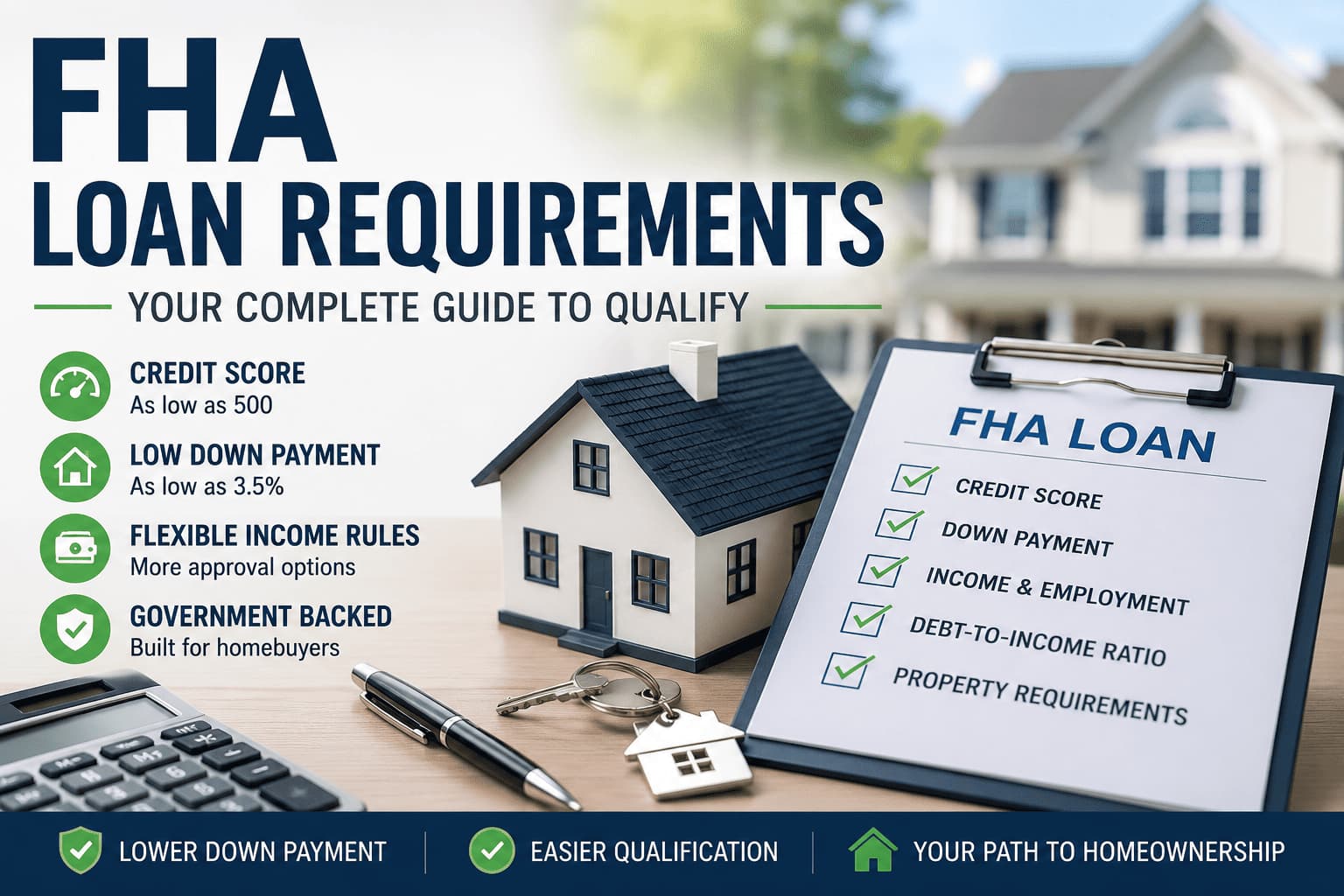
FHA Loan Requirements
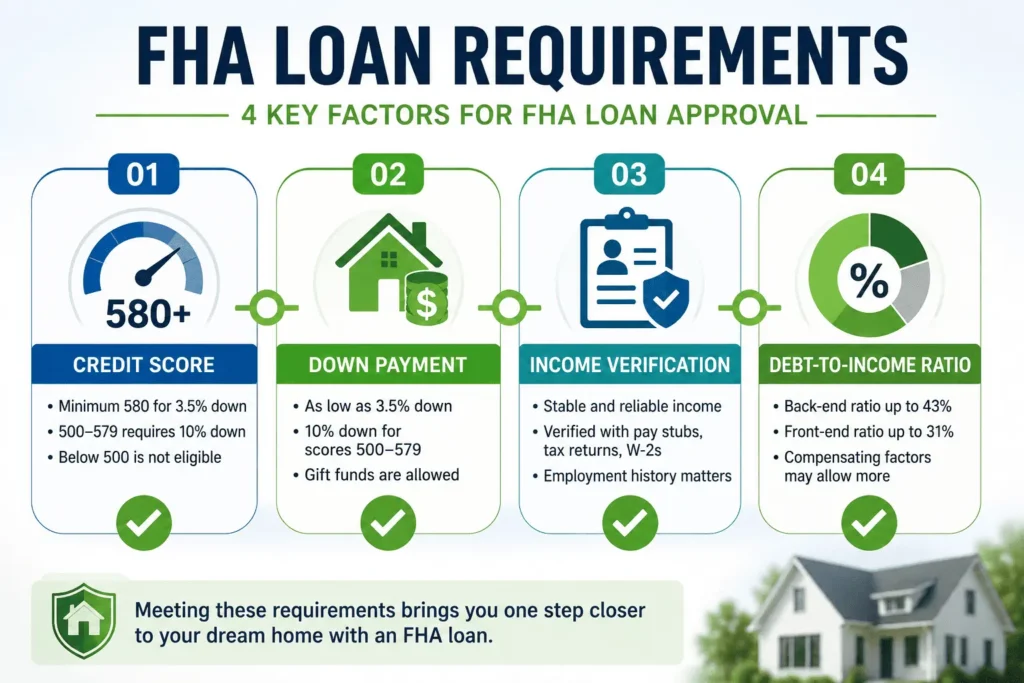
Every rule here comes from the HUD Single Family Housing Policy Handbook 4000.1. Lenders may add a stricter layer called an overlay. So the FHA Loan Requirements act as the floor, not the ceiling, and two lenders can give two answers on one file. Always ask whether a “no” is a HUD rule or that lender’s policy.
Basic Eligibility Requirements
FHA loan eligibility starts with a short list that rarely bends.
- A valid Social Security number.
- Lawful residency in the United States.
- Legal age to sign a mortgage in your state.
- The home must be your primary residence.
- The property must pass an FHA appraisal.
- No delinquent federal debt, including defaulted student loans.
A defaulted federal student loan stops the file until it is paid or in a valid rehabilitation plan.
Minimum Credit Score
FHA credit requirements come in two tiers, and the tier sets your down payment.
- 580 or higher: 3.5% down.
- 500 to 579: 10% down.
- Below 500: not eligible.
Most lenders set their own floor between 600 and 640, even though HUD allows 580, so shop around before assuming you are out.
History matters as much as the number. Late mortgage payments, fresh collections, and open judgments all draw attention. Bankruptcy means a two-year wait for Chapter 7 and one year inside a Chapter 13 with court approval. Foreclosure means a three-year wait from the title transfer date.
Minimum Down Payment
Your down payment is 3.5% of the sales price or appraised value, whichever is lower. On a $300,000 home, that is $10,500. With a score of 500 to 579, it jumps to 10%, or $30,000 on the same house.
The money does not have to be yours. FHA allows 100% gift funds from a relative, employer, labor union, or approved assistance program. The giver signs a letter stating it is not a loan, and lenders trace the transfer.
Income Requirements
There is no income cap and no minimum salary. FHA income requirements are about stability and proof, not size. Underwriters want income that is steady, likely to last three more years, and easy to document.
Many income types count toward qualifying:
- Salary, hourly wages, and regular overtime.
- Bonus and commission with a two-year history.
- Self-employment profit with two years of returns.
- Child support and alimony with a court order and payment record.
- Social Security, pension, and disability benefits.
- Rent from a multi-unit property you will occupy.
Part-time work counts once it has run two years; a brand-new side job does not.
Employment & Income Verification
FHA employment requirements ask for a two-year work history, not two years at one desk. Job changes are fine when you stay in the same field or move up. A gap over six months usually means six months back on the job first.
Expect the lender to pull:
- Last 30 days of pay stubs.
- Two years of W-2s or 1099s.
- Two years of tax returns if you are self-employed.
- A verbal check with your employer within 10 days of closing.
That final call is why nobody should quit during escrow.
Debt-to-Income (DTI) Ratio
DTI compares monthly debt payments to gross monthly income. The standard limit is 43%. With strong compensating factors and an automated approval, FHA loan guidelines let files stretch to 56.9%.
Two ratios get measured:
- Front-end ratio: the housing payment alone, usually capped near 31%.
- Back-end ratio: housing plus every other monthly debt.
Cash reserves, a long job history, and solid residual income count in your favor.
Documentation Required
Gather these before you apply and the file moves faster.
- Two years of tax returns and W-2s.
- 30 days of pay stubs.
- Two months of bank statements, all pages.
- Signed purchase agreement.
- Gift letter and donor bank records, if used.
- Divorce decree, support order, or bankruptcy discharge, when they apply.
Missing pages are the top delay in meeting requirements for FHA loan approval. Send complete statements, even the blank final page.
FHA Property Requirements
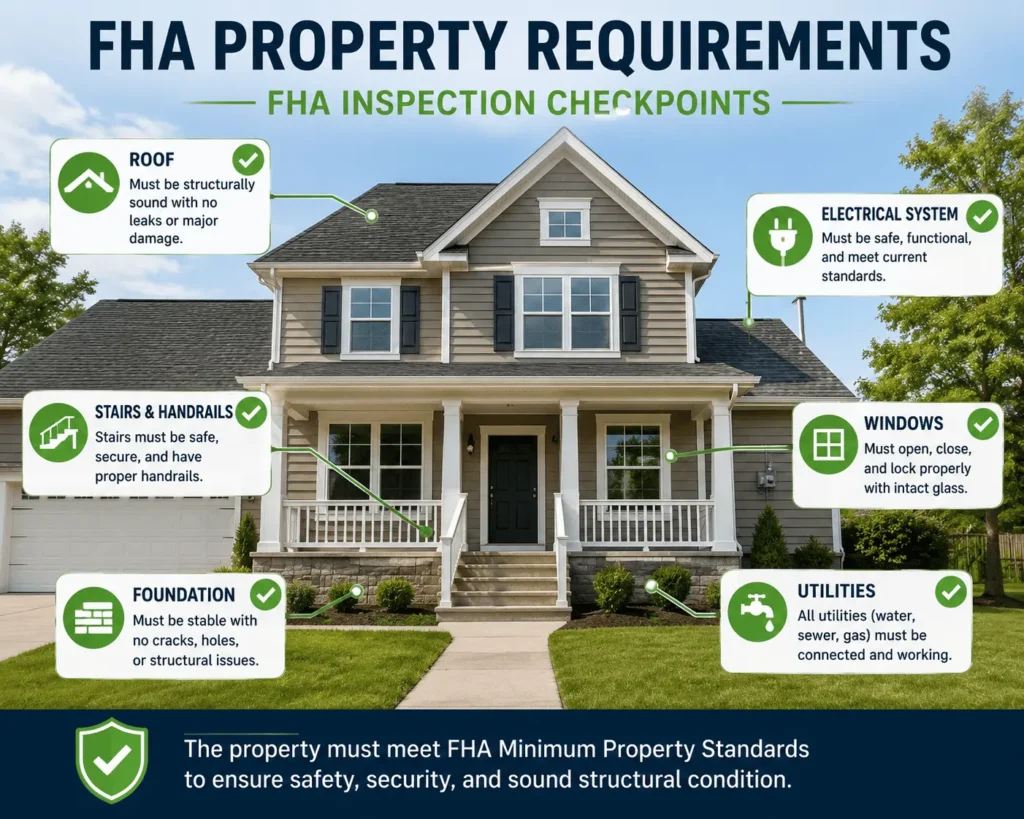
The house has to qualify too, and this is where deals fall apart. Half of the FHA Loan Requirements apply to you, half to the property. The FHA insures that house as collateral, so it wants safe, sound, and secure.
FHA Minimum Property Standards
HUD calls these Minimum Property Standards, and the appraiser tests them against three words.
- Safety: the home protects the health of the people inside.
- Security: the home protects the property itself.
- Soundness: no structural defect threatens the building.
This is not a home inspection. FHA loan rules ask the appraiser to judge value and obvious hazards only, so hire a private inspector too.
Eligible Property Types
FHA financing covers more than a single house.
- Detached single-family homes.
- Two-, three-, and four-unit buildings, if you live in one unit.
- FHA-approved condominiums, townhouses, or a unit through spot approval.
- Manufactured homes on a permanent foundation, built after June 15, 1976.
Vacation homes, pure rentals, working farms, and heavily commercial buildings are out.
Owner-Occupancy Requirement
You must move in within 60 days of closing and live there as your main home for at least one year. That rule keeps investors out. Buying a duplex and renting the other side is fine, as long as you occupy one unit.
FHA Appraisal Guidelines
An FHA appraisal does two jobs. It sets the value and checks the condition. The appraiser comes from the FHA roster, not from you or the seller.
A few points worth knowing:
- The appraisal ties to the FHA case number, not to the lender.
- Most appraisals stay valid for 180 days.
- If the deal dies, that appraisal follows the property to the next FHA buyer.
- A low value means you renegotiate, cover the gap in cash, or walk.
FHA Loan Limits
HUD caps how much you can borrow, and the cap changes by county and unit count. For 2026, the national floor for a one-unit home is $541,287, and the high-cost ceiling is $1,249,125.
Floor amounts for 2026 run like this:
- One unit: $541,287
- Two units: $693,050
- Three units: $837,700
- Four units: $1,041,125
High-cost counties go higher, up to $2,402,625 for a four-unit building, and Alaska, Hawaii, Guam, and the U.S. Virgin Islands get special exception limits. Check your county first, since neighbors can carry different caps.
FHA Property Standards Checklist
Appraisers flag the same items over and over. Walk the home with this list before you write an offer, because property condition is where the FHA Loan Requirements bite hardest.
Roof Requirements
The roof must keep water out and have at least two years of life left. Three or more shingle layers calls for a full tear-off. Missing shingles, active leaks, and stained ceilings all trigger repair conditions.
Peeling Paint
For homes built before 1978, chipping paint is treated as a lead hazard. The appraiser will require scraping, priming, and repainting on every affected surface, including garages, sheds, porch rails, and window sills. Newer homes get flagged only when bare wood sits exposed.
Attic Space
The appraiser needs a head-and-shoulders view into the attic, so a sealed hatch or packed closet blocks the visit. They check for leaks, daylight through the sheathing, rot, and missing insulation. Clear the hatch first and skip a second trip fee.
Street Access
The property needs safe, year-round access from a public or permanent private road. A shared driveway needs a recorded easement and a written maintenance agreement. Gravel and dirt roads pass when they stay usable all year.
Utilities & Safety Standards
The appraiser turns things on. Electric, gas, water, and heat must be live on inspection day.
Items that commonly get called out:
- No permanent heat source in living areas.
- Exposed wiring or open junction boxes.
- Missing handrails on stairs with three or more steps.
- Broken windows or a missing exterior door lock.
- Standing water, active pests, or visible foundation cracks.
Vacant homes with the power off are a common problem, so ask the seller to restore utilities first.
Common FHA Property Issues
Most appraisals come back clean, and when they do not, the fix is smaller than people fear.
What Happens if the Property Fails Inspection?
A property does not really fail. The appraisal returns “subject to repairs,” and the loan cannot close until those items are done. A re-inspection confirms the work and adds about a week.
Who pays is a negotiation. Sellers often handle repairs to keep the sale alive, and buyers sometimes pay when the price is worth it. A repair escrow can cover weather delays, like exterior paint in winter.
How to Fix FHA Appraisal Issues
Work the list in order of cost and speed.
- Handle cheap safety items yourself, such as handrails and smoke alarms.
- Use licensed contractors for roof, electrical, and plumbing conditions.
- Keep every receipt and take dated photos of finished work.
- Request the re-inspection only after all items are complete.
A home with structural damage or an unusable kitchen belongs in a renovation loan instead.
FHA Mortgage Insurance (MIP)
Mortgage insurance is the price of the government guarantee. It protects the lender, not you, and it is the costliest piece of the FHA Loan Requirements over a full loan term.
Is Mortgage Insurance Required?
Yes, on every FHA loan, no matter how much you put down. There is no way to buy it out or waive it. On a conventional loan, 20% down removes private mortgage insurance immediately.
Do not confuse MIP with your homeowners policy. Homeowners coverage protects the house and is billed through escrow, handled by your servicer’s insurance department after closing. Whether the loan lands with Guild or Valon, that office reviews policies and claim checks, not MIP.
Upfront vs. Annual MIP
There are two premiums, and they work differently.
- Upfront MIP (UFMIP): 1.75% of the base loan amount, paid at closing or rolled into the loan.
- Annual MIP: 0.15% to 0.75% of the balance, split into 12 payments on your monthly bill.
Almost every borrower finances the upfront premium instead of paying it in cash.
MIP Costs
Most 30-year borrowers with the minimum down payment pay 0.55% annually. On a $300,000 base loan, that looks like this:
- Upfront MIP: $5,250, usually financed.
- Annual MIP: $1,650 per year, about $137 per month.
- First-year total: roughly $6,900.
Loans above the county floor and loans in high-cost areas carry a higher annual rate. A 15-year term with 10% down drops it sharply.
How to Remove MIP
The removal rule depends on what you put down at closing.
- Less than 10% down: MIP stays for the life of the loan.
- 10% or more down: MIP falls off after 11 years.
If you are in the first group, refinancing into a conventional loan at 20% equity is the only clean exit. That move works best once your score improves, so watch current lender pricing and run the full break-even math, not just the payment change.
FHA Loan Closing Costs
Closing costs usually land between 2% and 6% of the purchase price, separate from your down payment and due the day you sign.
Typical Closing Costs
Expect a mix of lender fees and third-party charges.
- Loan origination and underwriting fees.
- FHA appraisal, generally $500 to $900.
- Title search, title insurance, and settlement fees.
- Recording fees and transfer taxes.
- Prepaid property taxes and homeowners insurance.
Your Loan Estimate arrives within three business days of applying. Compare it line by line against the Closing Disclosure you get before signing.
Seller Contributions
FHA lets the seller pay up to 6% of the sales price toward your closing costs. That cap is one of the strongest reasons to use FHA in a slow market. The credit covers origination fees, title charges, prepaid taxes, and points, but not your down payment.
Ask for it inside your offer, not after. One detail people miss is the hazard policy: your lender must appear on it, and a wrong mortgagee clause can delay closing by days.
FHA Closing Cost Limits
HUD sets no hard dollar cap, but it controls what you can be charged, and lenders may not pass along fees such as tax service charges. Contributions above 6% get subtracted from the sales price, shrinking your loan.
Types of FHA Loans
The FHA runs several programs under one roof, and picking the right one matters.
Traditional FHA Loan
The standard purchase loan for a move-in-ready home, and what most people mean by “FHA loan.” Fixed 15-year and 30-year terms are most common, and adjustable versions exist.
FHA 203(b) Loan
The 203(b) is the official name for that basic purchase program. It covers one- to four-unit primary residences at 3.5% down, and every rule above applies directly.
FHA 203(k) Loan
This one wraps the purchase price and renovation budget into one mortgage. The Limited version handles cosmetic work up to $75,000 with no structural changes. The Standard version covers major repairs and additions and needs a HUD consultant. It is the answer when a home cannot pass the appraisal as-is.
FHA Energy Efficient Mortgage (EEM)
An EEM lets you borrow extra for energy upgrades without a bigger down payment, such as insulation, windows, a heat pump, or solar. The added cost must be less than the energy the upgrades save.
FHA Streamline Refinance
A Streamline lowers the rate on an existing FHA loan with almost no paperwork: usually no appraisal, no income documents, and no new credit check. You need six months of payments made and a real benefit, like a lower rate.
Your servicer still has to issue a payoff figure. Whether you request a payoff statement from Guild, from Valon, or from Carrington, that number carries per diem interest and never matches your statement balance.
FHA Refinance
Beyond the Streamline, FHA offers rate-and-term and cash-out refinances. Cash-out is capped at 80% of your home’s value and needs a full appraisal. A rehab refinance can fold repair money into the new loan.
FHA Title I Loan
A Title I loan funds property improvements without touching your first mortgage. It works on homes without enough equity for a home equity loan, and manufactured homes and lots qualify too.
Section 245(a) Loan
The Graduated Payment Mortgage starts with a low payment that rises on a set schedule. It suits buyers who expect income to climb, like residents finishing medical training. A Growing Equity version raises payments to retire the loan faster.
Home Equity Conversion Mortgage (HECM)
The HECM is the FHA’s insured reverse mortgage, open to homeowners 62 and older. It converts equity into cash with no monthly mortgage payment required, though you still owe taxes, insurance, and upkeep. The 2026 maximum claim amount is $1,249,125 nationwide.
FHA Loan vs. Conventional Loan
This comparison decides most files, and neither option wins for everybody.
| Factor | FHA Loan | Conventional Loan |
|---|---|---|
| Minimum credit score | 500 with 10% down, 580 with 3.5% down | Usually 620 |
| Minimum down payment | 3.5% | 3% for many first-time buyers |
| Mortgage insurance | Required on every loan | Only under 20% equity |
| Insurance removal | 11 years, or life of loan | Cancels at 20% equity |
| Max DTI | Up to 56.9% with approval | Typically 45% to 50% |
| Seller credit cap | 6% | 3% to 9%, based on down payment |
| Property condition rules | Strict appraisal standards | More flexible |
| Loan assumable | Yes | Rarely |
FHA wins on approval odds, and conventional wins on long-run cost. Because FHA loan qualifications are looser, buyers with thin credit files often have no real second choice. If your score clears 700 and you can reach 5% down, price both, comparing a servicer-backed quote against an online lender estimate on the same day.
How to Apply for an FHA Loan
The path is more predictable than buyers expect. Meeting the FHA Loan Requirements on paper is half the job, and documenting your qualifications for FHA loan approval is the other half.
Step-by-Step Application Process
- Check your credit. Pull all three reports and fix errors first.
- Set your budget. Include MIP, taxes, and insurance, not just principal and interest.
- Get pre-approved. A real pre-approval means documents reviewed, not a quick quote.
- Find the home. Keep property standards in mind while touring.
- Sign the contract. Ask for seller credits inside the offer.
- Order the appraisal. Your lender pulls the FHA case number and assigns it.
- Complete underwriting. Answer document requests within 24 hours.
- Clear conditions and close. Walk the home one last time, then sign.
After closing, set up online access right away. Portals differ by company, so bookmark the right one for Carrington, Citizens, Valon, or Guild.
Your first payment is due on the first day of the second month after closing. Paying online or by autopay is safest, since checks mailed to the wrong office sit unopened. If you mail one, confirm the correct payment address first, because servicers use separate addresses for payments, payoffs, and insurance papers.
Finding an FHA-Approved Lender
Not every mortgage company can write FHA paper. The lender must hold HUD approval, which you can verify on the HUD Lender List Search.
Ask each lender three questions:
- What is your minimum credit score for FHA?
- Do you have overlays beyond HUD rules?
- What is your average time from contract to closing?
Compare at least three written Loan Estimates. Reading a lender review or a bank mortgage guide first helps you spot fee patterns. Credit pulls inside a 45-day window count as one inquiry, so shop freely.
If something looks wrong after closing, call early instead of waiting. A short call to Carrington, Valon, or Guild support usually beats a written dispute.
Required Documents
Keep digital copies of the master list above in one folder and name each file clearly. Underwriters ask for updated statements near closing, so expect a second round.
Should You Get an FHA Loan?
This is a personal math problem, not a universal answer. Clearing the FHA Loan Requirements and choosing this loan are two separate decisions.
Pros and Cons
Pros
- Low barrier to entry on credit and cash.
- Generous seller credits in buyer-friendly markets.
- Assumable, which gains value in a high-rate era.
- Renovation financing built into the program.
Cons
- Mortgage insurance for the life of most loans.
- Strict property condition standards.
- County loan limits can block higher-priced homes.
- Some sellers prefer conventional offers in bidding wars.
Who Should Choose an FHA Loan?
FHA fits best when conventional approval is out of reach today. Credit in the 500s or low 600s, a debt load above 45%, or a gifted down payment all point this way. Buyers rebuilding after bankruptcy or foreclosure clear the requirements for FHA home loan approval sooner than elsewhere.
Skip it if your score tops 720 and you can put 5% or more down, since conventional usually costs less over ten years. Many owners use FHA to get in, build equity, then refinance out or tap that equity through a home equity line.
Alternatives to FHA Loans
Three other programs beat FHA for the right borrower.
Conventional Loans
Backed by Fannie Mae and Freddie Mac instead of the government. HomeReady and Home Possible allow 3% down for eligible first-time buyers, and mortgage insurance cancels at 20% equity. Pull a bank rate comparison beside your FHA quote so the gap shows as real numbers.
VA Loans
For veterans, active-duty service members, and many surviving spouses. Zero down payment, no monthly mortgage insurance, and competitive rates. A one-time funding fee applies, waived for a service-connected disability. If you hold VA entitlement, check it before testing FHA eligibility.
USDA Loans
For homes in eligible rural and many suburban areas. No down payment, with a 1% upfront guarantee fee and a 0.35% annual fee, both lower than FHA. Income caps apply and vary by county, so check the address on the USDA map first.
Conclusion
This guide opened with a promise to replace mixed messages with one straight answer, and every section above delivers it. You now know the FHA Loan Requirements for credit, income, debt, property condition, insurance, and closing costs, plus the numbers behind each rule. Use the property checklist before you tour, collect three written Loan Estimates, and confirm whether a lender’s “no” is a HUD rule or an overlay.
Frequently Asked Questions
Can I buy a duplex with an FHA loan and rent the other unit?
Yes. FHA allows two- to four-unit properties as long as you live in one unit as your primary residence. Projected rent from the other units may even help you qualify, subject to an appraiser’s rent schedule and lender review.
Does an FHA loan take longer to close than a conventional loan?
Not usually. Most FHA files close in 30 to 45 days, the same range as conventional. Delays come from appraisal repair conditions or slow document returns, not from the program itself. Fast responses keep the timeline normal.
Can I get an FHA loan while I still owe on another FHA mortgage?
Generally no, because the program limits you to one loan at a time. Exceptions exist for a documented job relocation, a growing family needing a larger home, or leaving a jointly owned property after divorce. Lender approval is required.
Will student loan debt stop my approval?
No, but it counts against you. Lenders use the actual payment shown on your credit report, or 0.5% of the outstanding balance when the payment reads zero. Deferred loans still count, and a defaulted federal loan must be cleared first.
What credit score do I need for the best FHA interest rate?
Pricing improves in tiers, and most lenders reserve their sharpest FHA pricing for scores above 720. Below that, rate adjustments climb gradually. Since MIP costs the same at every score, your rate is where credit repair pays off most.