

Table of Contents
You have spent years paying down your mortgage, and your Indiana home is now worth a lot more than you owe on it. Maybe you want cash for a kitchen remodel, or you want to pay off high-interest credit card debt. You call Carrington, expecting a simple line of credit, and the answers you get back only raise more questions. This confusion around Carrington Home Equity & HELOC options is more common than you think, and most lender review sites only make it worse with mixed and contradicting information.
This guide clears up the confusion for good. You will learn exactly what Carrington offers, why a true HELOC is not one of those options, and what smarter paths you can take instead. You will also see real eligibility rules, cost ranges, and alternatives, so you walk away with a clear next step instead of more questions.
Does Carrington Offer Home Equity Loans or HELOCs in 2026?
The short answer is no, not in the traditional sense. Carrington Mortgage Services does not offer a standalone home equity line of credit to everyday borrowers. This is why you may have seen conflicting answers when researching Carrington Home Equity & HELOC questions online.
Some review sites say Carrington offers home equity loans but skip the HELOC part entirely. Others say Carrington offers neither product at all. The real picture sits in the middle, and both answers are only half correct. Carrington does give you access to your home’s equity, just not through a revolving credit line you can draw from again and again.
Instead, the company leans on cash-out refinancing as its main tool, along with a second lien product that only some borrowers can reach. Knowing this upfront saves you from wasting time on the wrong application or calling the wrong department. It also explains why big comparison sites list Carrington’s home equity features so differently from one another.
Why Carrington Doesn’t Offer a Traditional HELOC
Carrington built its entire business around specialty and non-QM loans. These are mortgages for people with credit challenges, self-employed income, or a past bankruptcy or foreclosure. A HELOC needs a very different kind of setup, one built for revolving credit lines that borrowers draw from slowly over many years.
Running a HELOC program means constant credit monitoring, rate adjustments, and draw period tracking. Many non-bank lenders skip this because it costs more to manage than a one-time refinance loan. Banks with large deposit bases can absorb that cost more easily, while a lender like Carrington focuses its resources elsewhere.
Carrington instead puts its energy into refinance products and flexible mortgage options for credit-challenged borrowers, which fits its lending model better. This choice keeps the company focused on what it already does well. It does leave a real gap for homeowners who want a simple, flexible line of credit rather than a full loan reset.
Another reason ties back to funding structure. Many non-bank lenders sell their loans to investors soon after closing, and a fixed loan is far easier to package and sell than a revolving credit line with a changing balance. A HELOC balance moves up and down every month, which makes it harder to bundle into standard mortgage-backed securities. This operational detail rarely gets mentioned in reviews, yet it explains a lot about why smaller lenders skip HELOCs entirely.
What Home Equity Options Carrington Actually Offers
Even without a HELOC, Carrington does not leave your equity completely untouched. The company offers two main paths, though one is far more common and accessible than the other.
Cash-Out Refinance
A cash-out refinance replaces your current mortgage with a new, larger one. You pocket the difference between your old loan balance and the new loan amount as cash at closing. This is the main way most Carrington borrowers pull equity out of their homes today.
The process works through Carrington’s Carrington Mortgage system, the same one used for standard refinancing. You go through a fresh underwriting process, get a new interest rate, and start a brand-new loan term. This is the closest thing Carrington offers to a Carrington Home Equity & HELOC solution, even though it works differently from a real credit line.
If you already have questions about your current balance before refinancing, check your Carrington Mortgage Payoff Request first so you know your exact starting numbers. Knowing this figure ahead of time helps you compare your new loan offer against what you already owe.
Closed-End Second Lien (Wholesale/Correspondent Only)
Carrington also offers a Closed-End Fixed-Rate Second Lien product. This works like a traditional second mortgage, sitting behind your first loan without disturbing it. The catch is that this product is only available through Carrington’s wholesale and correspondent lending channels, meaning you need to work with a mortgage broker rather than apply directly with Carrington.
This option keeps your first mortgage rate untouched, which matters a lot if you locked in a low rate a few years back. It is not widely marketed to everyday borrowers, so many people never hear about it unless they specifically ask a broker who works with Carrington’s wholesale side.
Carrington Home Equity Rates and Costs (2026)
Carrington does not post fixed rates for its home equity products anywhere online. This matches the pattern across its whole lending business, where rates depend heavily on your credit score, loan amount, and property location. You will need to speak with a loan officer directly to get a real number for your situation.
That said, a few cost patterns hold true across most Carrington Home Equity & HELOC research from third-party lender reviews. Cash-out refinances typically carry closing costs between two and five percent of your new loan amount. These include appraisal fees, title work, recording fees, and origination charges that get added into your new loan balance.
Second lien loans through the wholesale channel often carry higher rates than a first mortgage, since second liens carry more risk for the lender if you default. Borrowers with stronger credit scores and lower loan-to-value ratios usually see better pricing on both products. You can check current published rates on standard mortgage products through Carrington Mortgage Rates as a starting reference point, even though home equity pricing will differ from purchase or standard refinance rates.
Eligibility Requirements for Carrington’s Home Equity Options
Qualifying for a cash-out refinance with Carrington follows rules similar to its other mortgage products, though the bar is slightly higher for cash-out deals. You will typically need a credit score of at least 620, though some non-QM programs accept lower scores depending on your income documentation. Your loan-to-value ratio matters just as much, and most lenders cap cash-out refinances around 80 percent of your home’s current value.
Here is a quick breakdown of what lenders usually check for this type of loan:
- Minimum credit score, often 620 or higher for conventional cash-out refinance programs
- Debt-to-income ratio, usually capped near 43 to 50 percent depending on the loan type
- Home equity remaining after cash-out, typically at least 20 percent of your home’s value
- Proof of income, which can include bank statements for self-employed borrowers
- Clean payment history on your current mortgage over the past 12 months
The second lien product through wholesale channels may carry different requirements, since individual brokers set some of their own guidelines within Carrington’s overall framework. It helps to ask your broker directly what credit score and equity level they need before you apply. If you are unsure which path fits your situation, you can send your questions to james@allthings-mortgage.com before you commit to any application.
How to Apply for Home Equity Access Through Carrington
Applying starts with a conversation, not a form. Call Carrington through the Carrington Mortgage Phone Number directory to reach the right department for refinancing. Ask directly about cash-out refinance options since that is the product most borrowers end up using for their Carrington Home Equity & HELOC goals.
Once you start the process, you will need recent pay stubs, tax returns, and a current mortgage statement ready to submit. Carrington will order a home appraisal to confirm your property’s current value before approving any loan amount. You can track your application status and upload documents through your Carrington Mortgage Login dashboard once your file is officially open.
Closing on a cash-out refinance usually takes 30 to 45 days from start to finish, which is similar to a standard purchase mortgage timeline. Delays most often happen when income documents are incomplete or the appraisal comes back lower than expected. Staying responsive to document requests keeps your file moving without extra waiting.
Cash-Out Refinance vs. HELOC: Which Should You Choose?
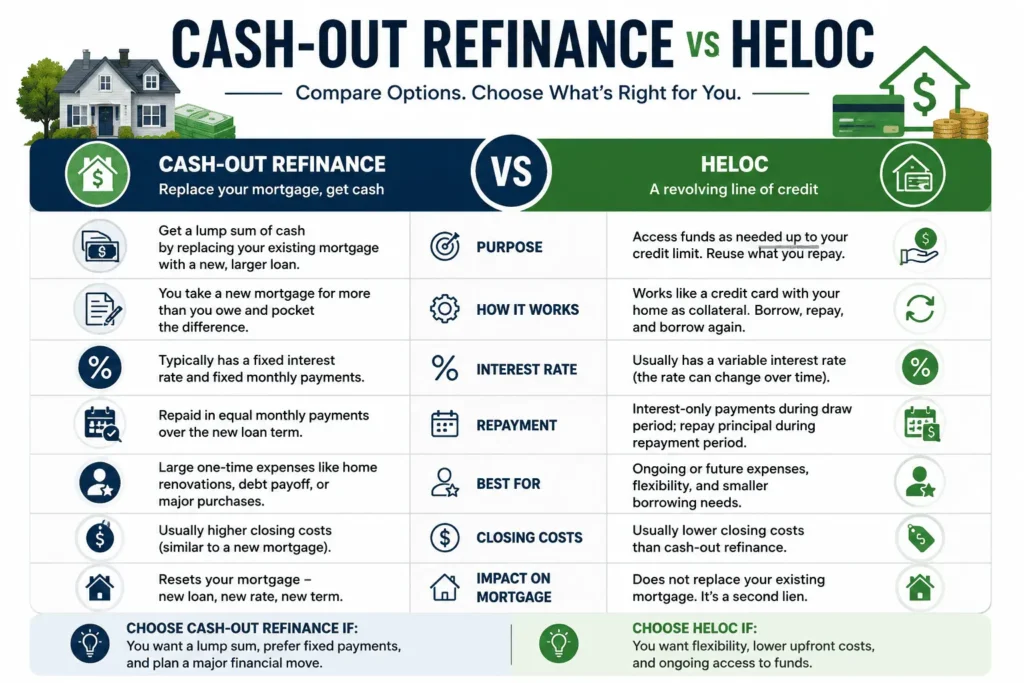
This is the real decision most people face when researching Carrington Home Equity & HELOC options. Since Carrington only offers one of these two paths directly, understanding the difference matters even more before you commit to an application.
| Feature | Cash-Out Refinance | HELOC |
|---|---|---|
| How it works | Replaces your whole mortgage | Adds a separate credit line |
| Interest rate | Usually fixed | Usually variable |
| Access to funds | One lump sum at closing | Draw as needed over time |
| Closing costs | Higher, full refinance costs | Lower, sometimes minimal |
| Best for | Large one-time expenses | Ongoing or unpredictable costs |
| Available at Carrington | Yes | No |
If you need a set amount for one project, like a roof replacement or a wedding, a cash-out refinance can work well since you get everything upfront. If you want flexible access to funds spread across months or years, a HELOC from a different lender fits your needs better. Since Carrington does not offer that second option directly, your choice may already be made for you if you plan to stay with this lender.
Who Should (and Shouldn’t) Use Carrington for Home Equity Needs
Carrington makes the most sense for borrowers who already have a mortgage there and want a single lump sum for a specific, known expense. Homeowners consolidating high-interest debt often benefit from a cash-out refinance, since the new rate is usually much lower than average credit card interest rates. Self-employed borrowers who struggled to qualify with traditional banks may also find Carrington’s flexible underwriting genuinely helpful here.
Carrington is not the right fit if you want ongoing access to funds, like a safety net for unpredictable home repairs that pop up over several years. It also is not ideal if your current mortgage rate is much lower than today’s market rates, since a cash-out refinance would replace that low rate entirely with a new one. Borrowers focused purely on getting the lowest possible home equity rate should compare several offers before committing to any single lender.
Think about a homeowner in Fort Wayne who bought their house five years ago with a Carrington FHA loan and now has a strong credit score. That borrower has real leverage to negotiate a good cash-out refinance rate and roll high-interest debt into one lower monthly payment. Compare that to a young family who just wants a small emergency fund available for the next few years without touching their mortgage rate at all. The second household is usually better served by a small HELOC elsewhere than by resetting an entire loan through Carrington.
Best Alternatives If You Need a True HELOC

If a revolving line of credit is what you actually need, several other lenders specialize in this exact product. Credit unions often offer competitive HELOC rates with lower fees than large national banks. Regional banks across Indiana frequently run HELOC promotions with reduced or no closing costs for a limited time each year.
Online lenders like Figure and Spring EQ focus specifically on home equity lines of credit and can close much faster than traditional banks. AmeriSave, unlike Carrington, offers both home equity loans and HELOCs directly, based on published lender comparisons from major review sites. Shopping around for a Carrington Home Equity & HELOC alternative takes an extra step, but it can save you thousands of dollars over the life of the loan.
Before you switch lenders completely, ask your local credit union what draw period and repayment terms they offer on a HELOC. Some credit unions let you draw for ten years and repay over twenty, while others use shorter windows that raise your monthly payment sooner. Getting two or three quotes side by side, including one from Carrington’s cash-out refinance team, gives you real numbers to compare instead of guesswork. For help comparing offers or reviewing your specific numbers, reach out to james@allthings-mortgage.com anytime.
Carrington Home Equity: Pros and Cons
Weighing the good and bad sides helps you decide faster, especially if you are comparing Carrington against a handful of other lenders. Carrington’s flexibility with credit-challenged borrowers is a real advantage, especially for people who got turned down by traditional banks elsewhere.
Pros:
- Accepts lower credit scores than many traditional lenders for cash-out refinance programs
- Cash-out refinance keeps everything under one loan and one monthly payment
- Self-employed and non-traditional income borrowers have real, workable options here
- Second lien product available through brokers without disturbing your existing first mortgage rate
Cons:
- No direct HELOC product available for everyday retail borrowers
- Rates are not published online, so comparison shopping takes extra effort and phone calls
- Cash-out refinance means resetting your entire loan term, rate, and closing costs
- Second lien access requires going through a broker, not Carrington directly
Overall, this Carrington Home Equity & HELOC trade-off comes down to flexibility versus simplicity, and your own financial situation will decide which one matters more.
Is Carrington Right for Your Home Equity Needs?
Carrington works well if you want a single, predictable loan through a cash-out refinance, especially if your credit history has a few bumps in it. It falls short if you need the flexibility of drawing funds over time, since a real HELOC is not part of its retail lineup right now. Before you decide, confirm your mailing details are correct using the Carrington Mortgage Address guide if you plan to send in any paperwork.
If your home equity plans depend on ongoing access to funds, it makes sense to compare Carrington against lenders who offer true HELOCs before signing anything. Also double check your homeowners insurance details are current with the Carrington Mortgage Insurance Department if you move forward with any refinance, since your policy will need updated loan information either way. And once your new loan closes, set up your monthly payments correctly through the Carrington Mortgage Payment portal so you avoid any late fees on your fresh loan term.
Conclusion
As promised at the start, this guide has cleared up exactly where Carrington stands on home equity access. You now know Carrington skips the traditional HELOC but still offers real ways to tap into your equity through cash-out refinancing and second lien loans. Understanding this Carrington Home Equity & HELOC picture puts you in a stronger position to choose the right path for your goals. Whether you stay with Carrington or shop elsewhere, you now have the facts to decide with confidence.
Frequently Asked Questions
Does Carrington offer a HELOC in 2026?
No, Carrington does not offer a standalone home equity line of credit to retail borrowers. It offers cash-out refinancing and a limited second lien product through wholesale brokers instead. Borrowers wanting a true HELOC need to look at other lenders or local credit unions.
What is the difference between Carrington’s cash-out refinance and a HELOC?
A cash-out refinance replaces your entire mortgage with a new, larger loan and gives you one lump sum. A HELOC adds a separate credit line you can draw from repeatedly over time. Carrington only offers the first option directly to homeowners.
What credit score do you need for Carrington’s home equity options?
Most cash-out refinance programs at Carrington require a credit score of 620 or higher. Some non-QM programs may accept lower scores depending on other factors like income and down payment size. Exact requirements depend on your loan type and property.
How long does Carrington’s cash-out refinance take to close?
A typical cash-out refinance with Carrington closes in about 30 to 45 days. This timeline includes appraisal, underwriting, and final document signing steps. Delays can happen if paperwork or income verification takes longer than expected.
Can you get a second mortgage with Carrington if you already have a first loan there?
Yes, through Carrington’s wholesale and correspondent lending channels, borrowers can access a Closed-End Fixed-Rate Second Lien. This lets you keep your current first mortgage rate completely untouched. You will need to apply through a participating mortgage broker rather than Carrington directly.