Table of Contents
You called Carrington twice this week and you still do not know your real interest rate. Every page you open repeats the same vague line about rates depending on credit score. That answer does not help when you are trying to compare loans before a rate lock runs out. I ran into this same wall last year while helping a client price out a Carrington loan, and it took real digging to find straight numbers.
This guide breaks down real Carrington Mortgage Rates using the company’s own weekly rate sheet, so you are not left guessing. You will see exact FHA, VA, and USDA pricing, learn what pushes your rate up or down, and walk away with a clear plan to lock in the best number you can get.
Who Is Carrington Mortgage Services?
Carrington Mortgage Services is a nonbank lender based in Orange, California. The company started in 2007 and has since worked with more than 1.4 million homeowners across the country. It lends in 49 states, and the only one left out right now is Massachusetts.
Carrington runs two sides of the business. One side services loans that came from other lenders. The other side, Carrington Home Loans, originates new mortgages and refinances. If you want the full picture of how the company works day to day, this Carrington Mortgage overview walks through logins, payments, and support in one place.
What sets Carrington apart is its manual underwriting process. Instead of leaning only on a credit score, a real loan officer reviews your full financial picture. That includes your rent history, your bank statements, and your job stability. This approach is a big reason Carrington Mortgage Rates keep coming up in searches from buyers who got turned away by traditional banks.
The company was built around helping people that most big banks tend to skip over. You can read more about that founding mission in this profile of James Peters and All Things Mortgage, which covers the community focus behind homeownership resources like this one.
Today’s Carrington Rate Sheet: FHA, VA & USDA Breakdown
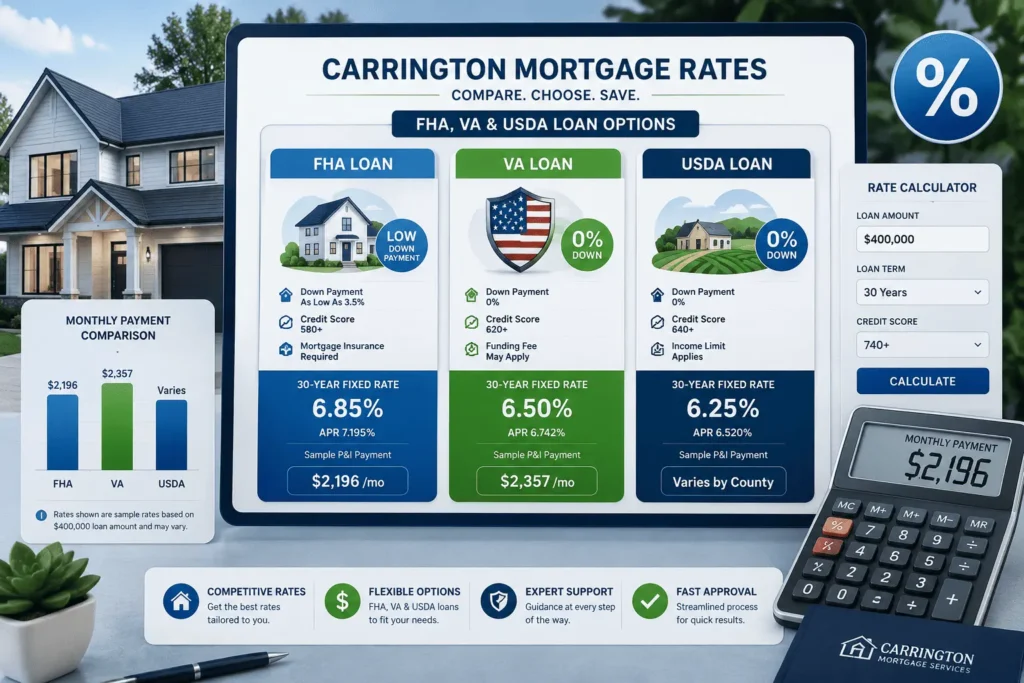
Most review sites will tell you Carrington hides its rates. That is only half true. The company actually publishes a weekly rate sheet, and it lists real numbers tied to specific loan assumptions.
Finding accurate Carrington Mortgage Rates usually means digging past the marketing pages on the main site. The weekly sheet sits in a separate section built for loan officers, but it is public, and anyone can check it before calling in for a quote. That single step saves you from walking into a conversation blind.
The table below shows a snapshot of that sheet, based on a $400,000 purchase price with a credit score of 740 or higher.
| Loan Type | Loan Amount | Down Payment | Sample Monthly P&I |
| FHA 30-Year | $360,000 | 10% | $2,196 |
| VA 30-Year | $400,000 | 0% | $2,357 |
| USDA 30-Year | $350,000 | 0% | Varies by county |
FHA 30-Year Pricing & Assumptions
The FHA 30-year rate on Carrington’s sheet includes close to 1.9 discount points. That means the borrower pays some money upfront to bring the rate down. FHA loans also carry both an upfront mortgage insurance premium and a yearly one, so your true monthly cost is higher than the rate alone suggests.
VA 30-Year Pricing & Assumptions
VA pricing follows the same discount point structure, again close to 1.9 points on the sample sheet. The big difference is the down payment. Qualified veterans and service members can finance the full purchase price with 0% down, though a VA funding fee still applies.
USDA 30-Year Pricing & Assumptions
USDA pricing on the sheet also assumes roughly 1.9 points and a 0% down payment. This loan type is built for rural and some suburban areas, so your final rate can shift based on where the property sits.
Understanding Discount Points in the Rate Sheet
Discount points are fees you pay at closing to lower your interest rate. One point usually costs 1% of your loan amount. Carrington’s sample rates already assume you are paying close to two points, so a zero-point loan from Carrington will likely price higher than what the sheet shows.
Buying a Home vs Refinancing: Rate Differences at Carrington
A purchase loan and a refinance loan do not always price the same, even at the same lender. Federal loan data shows Carrington’s average purchase rate sits lower than its average refinance rate. Cash-out refinances in particular tend to carry a slightly higher rate than a standard rate-and-term refinance.
If you are refinancing to pull cash out, expect your quote to run a bit higher than the purchase numbers on the weekly sheet. If you are refinancing only to lower your payment, your pricing should land closer to those purchase figures. Either way, ask your loan officer to show you both scenarios side by side before you pick one.
How Carrington Rates Compare to the National Average
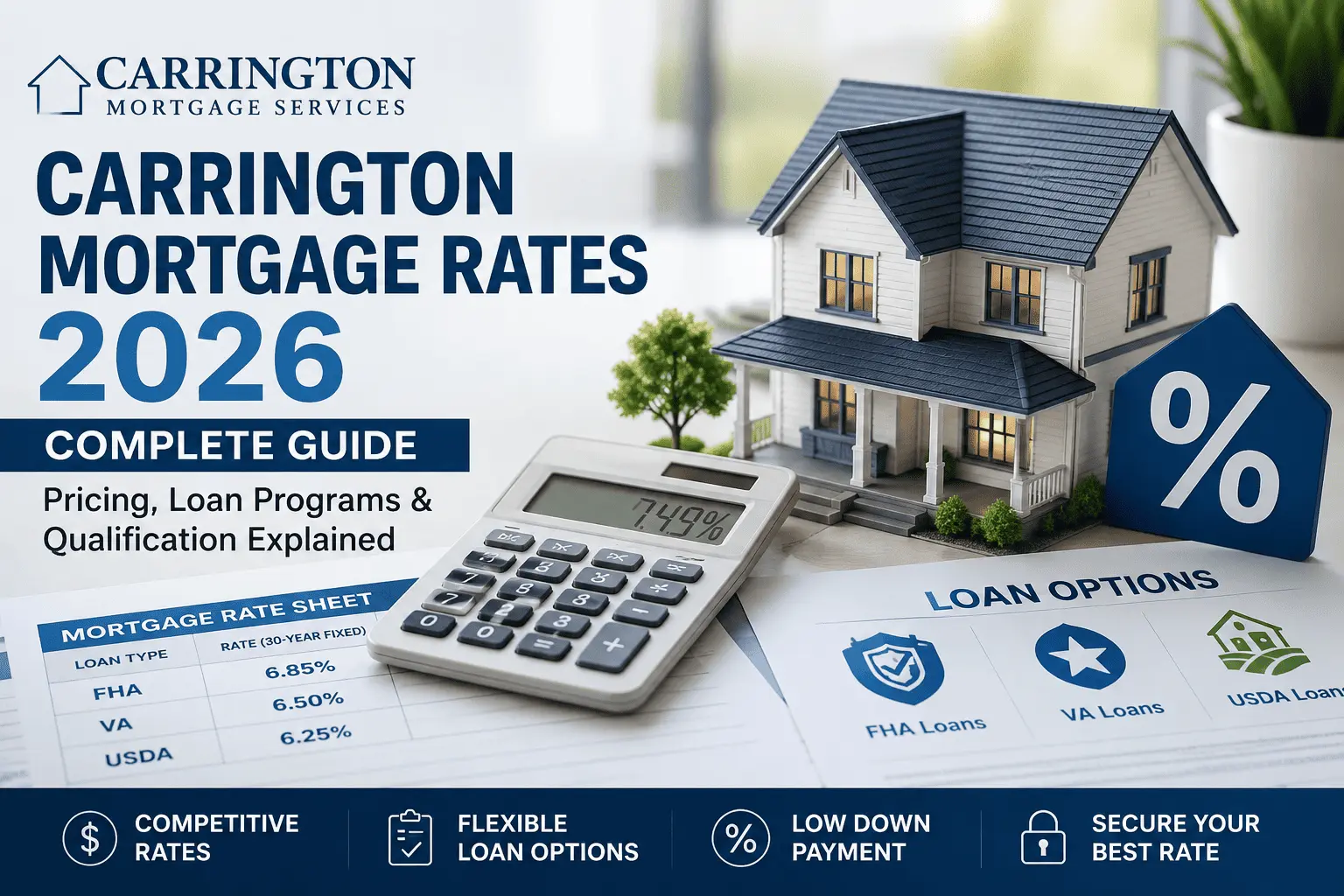
Recent lending data puts Carrington’s average 30-year fixed rate at about 7.49%, compared to a national average near 6.55%. That is roughly a 0.94% gap above the market. Carrington also runs on the higher end for total closing costs, with an average near $10,529 against a national average closer to $8,356.
That gap does not mean Carrington is a bad fit for everyone. Borrowers with lower credit scores or a recent bankruptcy often cannot get approved elsewhere at all. For that group, slightly higher Carrington Mortgage Rates can still beat no approval whatsoever.
Shopping around still matters, even if you plan to stick with Carrington in the end. If you want a side-by-side look at how other servicers price similar loans, this breakdown of Guild Mortgage interest rates and this guide to Valon Mortgage rates both cover the same rate-lock approach used here, so the numbers line up fairly.
Mortgage Programs Available Through Carrington
Carrington offers a wide mix of loan programs, which is part of why so many borrowers land here after being turned down elsewhere. Below is a quick look at what is on the menu.
- Conventional fixed-rate loans
- FHA loans for lower credit scores
- VA loans for veterans and service members
- USDA loans for rural properties
- Jumbo loans for high-value homes
- Adjustable-rate mortgages
- Non-QM loans for self-employed borrowers
15 & 30-Year Fixed Conventional Loans
Conventional loans come in 15-year and 30-year terms, and both carry a fixed rate for the full life of the loan. Carrington also offers Home Possible loans, which allow a down payment as low as 5%. These loans work well for borrowers with steady income and a solid credit history.
FHA-Backed Financing
FHA loans through Carrington accept credit scores as low as 500, which is far below most conventional guidelines. You can put down as little as 3.5% if your score is 580 or higher. Borrowers below that threshold usually need a 10% down payment instead.
VA Loans for Veterans and Service Members
VA loans require no down payment and no private mortgage insurance, which keeps the monthly payment lower than most other loan types. Carrington accepts credit scores as low as 500 for this program, though only the 30-year fixed term is available. A VA funding fee still applies unless you qualify for a waiver.
USDA Rural Development Loans
USDA loans are built for buyers purchasing in eligible rural or suburban zones. Carrington accepts credit scores as low as 550 for this program, and no down payment is required. Household income limits apply, so check your county’s cap before you start shopping.
Jumbo Loan Pricing
Jumbo loans cover any amount above the conforming limit, which runs from roughly $832,750 up to $1,249,125 depending on your location. Carrington can lend up to $2.5 million on a jumbo loan. You will typically need at least 20% down, since jumbo financing usually caps at 80% loan-to-value.
5/1, 7/1 & 10/1 Adjustable-Rate Options
Adjustable-rate mortgages start with a lower fixed rate for a set number of years before adjusting annually. A 5/1 ARM holds its rate for five years, a 7/1 ARM for seven years, and a 10/1 ARM for ten years. These loans suit buyers who plan to sell or refinance before the fixed period ends.
Non-QM Loans for Self-Employed & Credit-Challenged Borrowers
Non-QM loans skip the standard income documentation rules that trip up self-employed borrowers. Carrington also uses these loans to help people recovering from a bankruptcy or foreclosure. None of these programs require private mortgage insurance, which can offset some of the higher rate.
Factors That Shape the Rate You’re Offered
Your final number will almost never match the sample sheet exactly. A handful of personal factors move Carrington Mortgage Rates up or down for each borrower, and knowing them ahead of time helps you negotiate with confidence.
Minimum Credit Score by Loan Program
Credit score requirements shift by program, and Carrington sits lower than most competitors across the board. FHA and VA loans accept scores as low as 500. USDA loans need at least 550, and non-QM programs vary case by case depending on the borrower’s full file.
How Your Down Payment Moves the Rate
A bigger down payment usually earns you a better rate, since it lowers the lender’s risk. Government-backed loans like VA and USDA skip this requirement entirely. Conventional and jumbo loans, on the other hand, reward a larger down payment with noticeably better pricing.
DTI Ratio Thresholds Carrington Looks At
Your debt-to-income ratio compares your monthly debt payments to your monthly income. Carrington does not publish a hard maximum, but borrowers with a DTI near 36% usually get the strongest pricing. VA and USDA loans tend to allow closer to 41%, while FHA loans can stretch toward 43% in some cases.
Closing Costs and Fees to Expect
Carrington’s total loan costs run higher than average, based on recent federal reporting. Typical fees include an origination charge, an application fee, and standard third-party costs like the appraisal. None of these fees are hidden on purpose, but Carrington does not lay them out clearly on its public pages, so most borrowers only see the full list once a loan officer sends the estimate.
Employees and their qualified family members get a break on some of these charges. That discount does not apply to the general public, so most buyers should plan around the average figures below rather than hope for a similar deal.
- Origination fee: usually $400 to $900
- Prepayment penalty: none on any Carrington loan
- Average total closing costs: roughly $10,529 based on recent data
- Discount points: optional, used to buy down your rate
If a fee on your loan estimate looks off, or you need a corrected mailing address for a payoff check, this Carrington Mortgage address guide lists the right office for each type of request.
Rate Lock Period: How It Works at Carrington
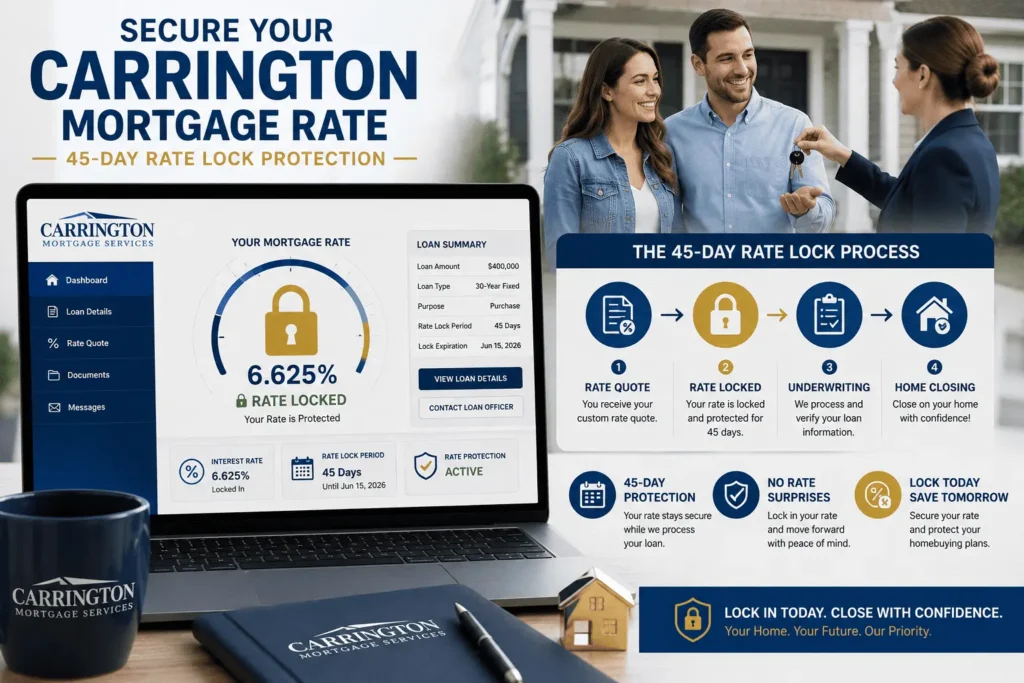
A rate lock freezes your interest rate for a set number of days while your loan moves through underwriting. Carrington’s sample pricing assumes a 45-day lock period. If your closing slips past that window, you may need to pay a fee to extend the lock or accept a new rate.
Locking early protects you from market swings, but it also means you are stuck with that rate if pricing drops afterward. Ask your loan officer whether a float-down option is available before you commit.
Most buyers lock their rate once the purchase contract is signed and the loan moves into full underwriting. Locking too early, before you have a firm closing date, can leave you paying extension fees through no fault of your own. A short conversation with your loan officer about your expected closing timeline usually prevents that headache entirely.
Step-by-Step: Requesting Your Custom Rate Quote
Getting a real, personalized number takes a few extra steps with Carrington compared to lenders that post rates openly online.
- Go to the Carrington website and select the “Buy a Home” option under the home loans tab.
- Enter your target purchase price, ZIP code, and estimated down payment.
- Add your income and an estimate of your credit score.
- Submit the form and wait for a loan officer to call or email with your quote.
- Compare that quote against your rate lock terms and closing cost estimate before signing anything.
You can also call in directly if you would rather skip the online form. Our team keeps updated contact details in this Carrington Mortgage phone number directory, sorted by department, so you reach the right desk on the first try. Once your loan is approved, you can manage payments and documents through the Carrington Mortgage login portal instead of waiting on hold. If your paperwork gets stuck or your quote does not match what you were told, our editorial desk can point you in the right direction at james@allthings-mortgage.com.
States Where Carrington Currently Lends
Carrington originates loans in every state except Massachusetts, which makes it one of the more widely available non-QM and government-loan lenders on the market. Coverage can still vary by county for certain programs, especially USDA loans, since income and property eligibility depend on local limits. It is worth confirming your specific county before you apply, particularly if you are close to a rural boundary line.
Borrowers in Indiana generally have access to the full lineup, including FHA, VA, USDA, and conventional programs. Rural counties across the state often qualify for USDA financing, which pairs well with Carrington’s low credit score threshold. Checking your county’s USDA eligibility map early can save you a wasted application if your target home sits just outside the boundary.
Carrington’s Track Record: Complaints, Ratings & App Reviews
Carrington is not accredited with the Better Business Bureau and currently holds a C+ rating there, largely due to unresolved consumer complaints. In late 2022, the Consumer Financial Protection Bureau fined the company $5.25 million for charging incorrect late fees and giving borrowers false information during a pandemic forbearance program.
Customer satisfaction scores from J.D. Power also sit below the industry average for mortgage servicing. That mostly reflects slower communication during loan transfers rather than problems with the actual loan terms. Borrowers who came to Carrington through a loan transfer report more confusion than those who applied directly.
On a brighter note, the mobile app has improved a lot in recent years. Current ratings sit around 4.8 on the App Store and 4.7 on Google Play, up from ratings in the 2 to 3 range just a couple of years back. If you are managing an existing loan and want to handle a payoff cleanly, this Carrington Mortgage payoff request guide walks through the exact numbers you need before you send a final check. Payment questions come up just as often, and this Carrington Mortgage payment guide covers every safe way to pay each month.
Weighing the Benefits and Drawbacks
Carrington is not the right fit for every borrower, but it solves a real problem for people who keep getting rejected elsewhere.
- Accepts credit scores as low as 500 on FHA and VA loans
- Uses manual underwriting instead of a strict automated cutoff
- Offers non-QM loans for self-employed and recently bankrupt borrowers
- Charges no prepayment penalty on any loan type
- Does not post sample rates clearly on its website
- Runs higher than average on total closing costs
- Not available in Massachusetts
- Only offers fixed rates on VA loans, with no ARM option there
Conclusion
Real Carrington Mortgage Rates are not as hidden as most review sites claim, once you know where to look on the weekly sheet. You now have the FHA, VA, and USDA numbers, the fees to expect, and a clear path to request your own personalized quote. Use the rate lock and discount point details above to compare offers before you commit to anything. If a question comes up during your application, reach our team directly at james@allthings-mortgage.com and we will help you sort it out.
Frequently Asked Questions
Can I check Carrington Mortgage Rates without contacting a loan officer?
Carrington does publish a weekly rate sheet with FHA, VA, and USDA sample pricing, but it does not show a live, personalized rate calculator online. You will still need to submit basic financial details before a loan officer sends you an exact number.
What’s the lowest credit score for a competitive rate?
Scores of 740 or higher unlock the sample pricing shown on Carrington’s rate sheet. Scores between 500 and 580 can still qualify for FHA or VA loans, but expect a higher rate and possibly a larger down payment requirement.
Will I be charged for paying off my loan early?
No. Carrington does not charge a prepayment penalty on any of its loan programs. You can pay extra toward your principal or pay off the full balance early without any added fee.
How often does Carrington update its rates?
Carrington’s weekly rate sheet updates on a regular weekly schedule, though the exact time can shift slightly week to week. Rates can also move mid-week if bond markets swing sharply, so always confirm the current number with a loan officer.
Does Carrington offer better Carrington Mortgage Rates for veterans?
VA loans through Carrington skip the down payment and private mortgage insurance requirement, which lowers the total monthly cost even if the listed rate looks similar to other programs. Veterans with lower credit scores also get more underwriting flexibility here than at many traditional banks.