

Table of Contents
You open your mailbox and there’s a check inside from your insurance company. But your mortgage company’s name is printed right next to yours on that same check. Have you run into this and wondered who you’re even supposed to call first? A lot of homeowners feel that exact same confusion the moment a claim check or a renewal notice shows up.
This guide breaks down exactly how the Carrington Mortgage Insurance Department works, from contact numbers to claim steps to what happens if your funds get delayed. By the end, you’ll know exactly who to call, what documents to prepare, and how the entire process moves from start to finish. No guesswork, no runaround, just a clear path forward.
What Is Carrington’s Insurance Department
Carrington’s insurance department handles everything connected to your home’s coverage. That includes hazard insurance, flood insurance, and any claim checks that come in after storm or fire damage.
This team also manages your escrow account if your policy gets paid through your monthly mortgage bill. If you’re new to how your loan works overall, our full guide on Carrington Mortgage covers the basics of your account and how servicing works day to day.
The Carrington Mortgage Insurance Department exists mainly to protect two things: your home and their financial stake in it. Since your lender holds your property as collateral, they need to confirm your coverage stays active and that any claim money gets used the right way.
Borrowers sometimes assume this department only steps in during a claim. In reality, they’re involved anytime your policy changes, renews, or lapses, which is why staying in touch with them matters even during a quiet year.
How to Contact Carrington’s Insurance Department

Carrington splits insurance-related support into two separate teams. Knowing which one to call saves you time and keeps you from getting transferred around in circles.
Both teams handle a high volume of calls, especially right after a major storm hits a region. Calling early in the day, close to when phone lines open, usually means a shorter wait on hold.
Whether you’re calling about escrow or a claim check, both teams fall under the same Carrington Mortgage Insurance Department umbrella. Mentioning your loan number right at the start of the call always speeds things up.
Customer Service Department (Escrow & General Insurance Questions)
For general insurance questions, escrow issues, or policy updates, call 1-800-561-4567. This line is open Monday through Friday, from 8:00 a.m. to 9:00 p.m. Eastern Time.
Use this number for things like adding a new insurance policy, checking your escrow balance, or asking why your monthly payment changed. For a full list of Carrington’s department numbers, check our Carrington Mortgage Phone Number directory, which breaks down every line by purpose.
SWBC Loss Draft Department (Insurance Claim Checks)
If you have an insurance claim check tied to property damage, that goes to a different team entirely. Carrington uses Southwest Business Corp, known as SWBC, to manage these claims on their behalf.
Call SWBC at 866-328-0343, open 8:00 a.m. to 8:00 p.m. Eastern Time, Monday through Friday. If you need to mail documents instead, our guide on the Carrington Mortgage Address lists the correct mailing address for loss draft claims, along with addresses for other departments.
If neither number answers your specific question, you can also email james@allthings-mortgage.com and we’ll help point you toward the right department.
Homeowners (Hazard) Insurance Requirements on a Carrington Loan
Your mortgage agreement requires active Carrington homeowners insurance at all times. This type of coverage protects against fire, wind, hail, and other physical damage to your home’s structure.
If your policy lapses even briefly, Carrington may purchase coverage on your behalf. That’s called force-placed insurance, and it almost always costs more than a policy you choose yourself. Keeping your policy current is the simplest way to avoid this extra expense.
Your coverage amount should match your home’s rebuild cost, not its current market value. These two numbers can be very different, especially in areas where construction costs have climbed. Talk to your insurance agent if you’re unsure whether your policy amount is actually enough to rebuild.
Most policies renew once a year, and Carrington expects proof of that renewal before the old policy expires. Set a personal reminder a few weeks before your renewal date so you’re never caught off guard. This one habit alone prevents most force-placed insurance situations before they ever start.
Flood Insurance Requirements for Carrington-Serviced Properties
If your home sits inside a designated flood zone, Carrington requires separate flood insurance. Regular hazard insurance never covers flood damage, so this is treated as a completely different policy.
You’ll need to show proof of flood coverage every single year. Carrington’s team checks this because federal rules require flood insurance on homes located in high-risk flood zones with a federally backed loan.
If your flood zone status ever changes, update your lender as soon as possible. Skipping this step can lead to force-placed flood coverage being added without warning, which tends to cost noticeably more than a standard policy.
Flood zone maps get updated by FEMA from time to time, not just when new construction happens nearby. It’s worth checking your zone status every couple of years, even if nothing on your property has changed. A shift from a low-risk zone to a high-risk one can happen without any warning letter in the mail.
How Your Escrow Account Pays Your Insurance Premium Through Carrington
Most Carrington borrowers pay their insurance premium through their Carrington escrow account. A portion of your monthly mortgage payment goes into this account, and Carrington pays your insurance bill automatically when it comes due.
This setup protects you from ever missing a payment deadline by accident. It also means your monthly mortgage payment can shift slightly each year if your insurance premium goes up or down. You can review exactly how your full payment breaks down in our Carrington Mortgage Payment guide.
If your escrow account runs short, Carrington will notify you by mail. You may see a temporary increase in your monthly payment to help cover that gap, spread out over the following twelve months.
Every year, Carrington reviews your escrow account to check for shortages or surpluses. If you paid in more than needed, you may get a small refund check. If you paid in less, expect a short letter explaining the new payment amount.
Shopping for Insurance Through Carrington’s Covered Program
Carrington partnered with a digital insurance marketplace called Covered to build the Carrington Covered insurance program. This tool lets you compare quotes from more than 40 insurance carriers in one single place, without calling each company individually.
You’re not required to use Covered at all. You can pick any insurance provider you want, as long as your coverage meets your loan’s requirements. But if your premium jumped recently at renewal, comparing rates through this tool can be a fast way to check if you’re overpaying compared to the market.
Covered also offers bundled options for auto, flood, and life insurance. Some homeowners end up saving money by combining several policies through one carrier instead of keeping them spread across different companies.
Getting a quote through Covered takes just a few minutes online, and there’s no obligation to switch. It’s a useful comparison tool even if you plan to stay with your current insurance company. Seeing other rates side by side gives you real leverage at your next renewal.
How to Update or Change Your Insurance Policy with Carrington
Switching insurance providers is common, especially if your rates jump at renewal time. When you do switch, you’ll need to send Carrington your new policy’s declarations page.
This one document confirms your coverage amount and lists Carrington as the mortgagee on file. Without it, your lender may assume you have no active coverage at all, which can accidentally trigger a force-placed policy. That mistake is avoidable if you send updated proof right away.
You can fax, mail, or upload this document through your online account. If you haven’t set up online access yet, our Carrington Mortgage Login guide walks through account setup step by step, including what to do if your first login attempt fails.
Give Carrington a few business days to process any policy update before assuming something went wrong. Following up with a phone call after a week is reasonable if you haven’t seen a confirmation yet.
Filing an Insurance Claim on a Carrington Mortgage
Filing a claim through the Carrington Mortgage Insurance Department follows a fairly predictable path. Knowing each step ahead of time makes the entire process feel a lot less overwhelming when damage actually happens.
Step 1 — Get Your Claim Approved and Endorse the Check
After storm or fire damage, your insurance adjuster inspects the property and approves your claim. For damage to your home’s structure specifically, the check will list both your name and Carrington’s name as payees.
You need to sign, or endorse, the check before anything else happens. This step tells Carrington that you received the funds and agree to send them forward for processing.
Step 2 — Send the Check to the Loss Draft Department
Once endorsed, mail or submit the check to Carrington’s loss draft team, handled through SWBC. Include your loan number on every single page of paperwork you send, even the cover letter.
Many borrowers now upload documents digitally instead of mailing them in. This route tends to move faster and gives you a timestamped record that your claim documents were actually received.
Step 3 — Small Claim vs. Large Claim Threshold
Smaller claims, often under $10,000 to $15,000, are typically endorsed and returned to you right away. Larger claims get placed into a separate escrow account, and funds are released in stages as repair work moves forward.
This threshold exists so lenders can confirm repair work is actually happening before releasing large sums of money. It protects both your interests and the long-term value of the property.
If you still have questions, reach out to james@allthings-mortgage.com and we’ll help you sort it out.
How Carrington Releases Large Claim Funds (Three-Part Disbursement)
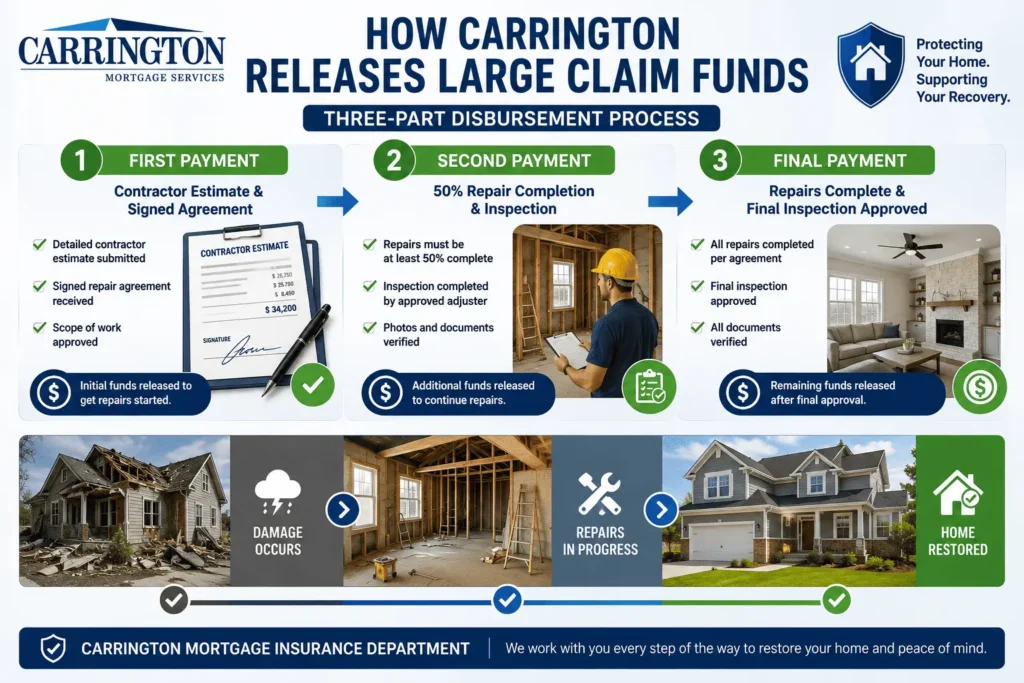
For bigger claims, Carrington typically releases funds in three separate parts. Each stage ties directly to a specific point in your repair project, rather than releasing everything all at once.
| Stage | When It’s Released | What Triggers It |
| First Payment | After claim approval | Contractor estimate and signed agreement submitted |
| Second Payment | Around 50% completion | Inspection confirms mid-project progress |
| Final Payment | After repairs finish | Final inspection passes |
This staged approach protects your contractor’s cash flow while giving Carrington proof that repairs are actually on track. Any leftover funds once repairs finish belong entirely to you, not the lender, so don’t assume unused money simply disappears.
Documents You Need to Get Your Insurance Funds Released
Missing paperwork is the single biggest reason claim payments get delayed. Having these documents ready before you even call can speed up the entire Carrington insurance claim process significantly.
- Signed contractor agreement showing the scope of work
- Detailed repair estimate with a full cost breakdown
- Contractor’s W-9 form for tax reporting
- Proof of contractor license and active insurance
- Progress photos for mid-project inspections
Keep both digital and printed copies of everything you submit. If your account is set up online, uploading through your dashboard is usually faster and more reliable than mailing physical paperwork through the postal system.
Double check every form for a missing signature before you send it. A single blank line is often the reason a whole packet gets sent back, which quietly adds another week or two to your timeline.
How Long Carrington Can Hold Your Insurance Check
There’s no single federal rule that sets an exact time limit for how long a lender can hold insurance funds. State laws vary quite a bit, and your specific repair timeline also plays a role in how long the process takes.
That said, Carrington cannot legally hold your money forever without a valid reason. The Real Estate Settlement Procedures Act requires servicers to handle escrow and claim funds properly, and without unnecessary delay.
If your repairs are complete but funds still haven’t arrived, that situation is worth escalating right away. Waiting too long without asking direct questions rarely speeds anything up on its own.
Most straightforward claims move through the entire process within a few weeks. Larger claims with staged inspections naturally take longer, simply because each stage depends on the repair work actually finishing first.
What to Do If Carrington Is Delaying Your Insurance Claim
If your claim feels stuck, start with a direct call to the loss draft department. Ask for a clear reason behind the delay and request a specific timeline for release.
If that first call doesn’t resolve things, request a supervisor review of your file. You can also submit a written notice of error, which legally requires Carrington to investigate your complaint and respond within a set number of days.
Still no resolution after that? You can file a formal complaint with the Consumer Financial Protection Bureau or your state attorney general’s office. Keep a written log of every call you make, including names, dates, and a short summary of what was said.
Escalating early is often the fastest way to get the Carrington Mortgage Insurance Department to actually move on your file. Waiting quietly rarely gets a faster response.
Force-Placed Insurance — What Happens If Your Coverage Lapses
If your homeowners policy lapses and you don’t replace it quickly, Carrington may buy a policy on your behalf. This is called force-placed insurance, and it mainly protects the lender’s financial interest in the home, not your personal belongings inside it.
Force-placed policies usually cost significantly more than a policy you shop for yourself. That added cost gets folded directly into your monthly payment through escrow, which can catch homeowners off guard when they open their next statement.
The easiest fix here is prevention. Send proof of your active policy the moment you renew or switch providers, so the Carrington Mortgage Insurance Department never has a reason to place their own coverage on your account.
Insurance Claims If You’re Behind on Your Mortgage Payments
Being behind on payments doesn’t automatically block your insurance claim from moving forward. As long as you’re actively working with Carrington on your account, most claims still follow the same normal process described above.
However, if a loan is seriously delinquent, a servicer may apply part of the insurance funds toward the outstanding balance instead of releasing everything for repairs. This decision gets handled case by case, so open communication with Carrington matters a great deal here. If you’re also exploring what it takes to close out your loan entirely, our Carrington Mortgage Payoff Request guide explains that separate process in detail.
Staying in regular contact with your servicer is the best way to avoid unpleasant surprises. Silence tends to make lenders more cautious, not less, especially when a claim involves a large dollar amount.
If money is genuinely tight, ask Carrington about loss mitigation options alongside your insurance claim. Handling both conversations together, rather than separately, often leads to a plan that actually fits your situation.
What Happens to Insurance Funds If Your Home Is a Total Loss
If your home is destroyed and you choose not to rebuild, Carrington cannot force you to reconstruct it. But since your property serves as collateral for the loan, remaining insurance funds may go toward paying down your mortgage balance instead.
You would still owe any difference between the payout amount and your remaining loan balance. This is one of the harder financial conversations homeowners face, so talk with Carrington early if you’re leaning toward this decision rather than waiting until the last minute.
Selling the land instead of rebuilding is sometimes an option too, depending on your local market conditions and zoning rules. Every situation looks a little different, so ask your loan officer what applies specifically to your property.
It also helps to loop in a housing counselor or attorney if the payout amount feels unclear. A second set of eyes on the numbers can catch details you might miss during an already stressful time.
Final Thoughts
Dealing with the Carrington Mortgage Insurance Department feels overwhelming the first time, but the process follows a clear structure once you know it. From contacting the right team to understanding how claim funds get released, each step exists to protect your home and your investment in it. Keep your documents ready, stay in touch with Carrington during any claim, and don’t hesitate to escalate if things stall. If you still have questions after reading this guide, reach out to james@allthings-mortgage.com and we’ll help you sort it out.
Frequently Asked Questions
Does Carrington require flood insurance on every home?
No. Flood insurance is only required if your property sits inside a federally designated flood zone. Carrington checks this using FEMA flood maps tied to your address, and updates the requirement if your zone status changes.
Can I choose my own insurance company with Carrington?
Yes. Carrington does not require you to use a specific provider or their Covered marketplace. You just need to send proof of coverage that meets your loan’s minimum requirements before your current policy expires.
Will my mortgage payment change if my insurance premium goes up?
Yes, if your insurance is paid through escrow. Carrington adjusts your monthly payment to cover the higher premium, and you may also see a one-time escrow shortage charge added to spread out the difference.
What if I never receive my insurance claim check?
Contact your insurance company first to confirm the check was actually mailed. If it was sent directly to Carrington, call the loss draft department at 866-328-0343 to confirm receipt and next steps.
Can Carrington deny my insurance claim?
No, Carrington doesn’t approve or deny insurance claims. That decision comes from your insurance company. Carrington’s role in the Carrington Mortgage Insurance Department only begins once a claim is approved and a check is issued.