

Table of Contents
Saving for three years and still hearing your down payment is too small is a rough moment. Plenty of buyers across Indiana hit that same wall, and the advice online only muddies it. One page says you need a 620 score, the next says 580, and nobody explains what the lender actually checks.
This guide fixes that gap. You will see exactly what an FHA loan is, who qualifies in 2026, what it costs monthly, and which rules changed this year. Every figure traces back to HUD guidance, written in plain language. By the last line you will know whether this path fits your budget.
What Is an FHA Loan?
An FHA mortgage is a home loan insured by the Federal Housing Administration, an agency inside the U.S. Department of Housing and Urban Development. The government does not lend you the money. A bank or mortgage company funds the deal, and federal insurance protects that lender if payments stop. That safety net is why a lender can accept a small down payment and an average credit score.
The program began in 1934. An FHA insured loan is used most often by first-time buyers, though repeat buyers qualify too. Here is the short version:
- Backed by: the Federal Housing Administration, under HUD
- Minimum down payment: 3.5% with a credit score of 580 or higher
- Lowest score allowed: 500, paired with 10% down
- Occupancy: the home must be your primary residence
- Mortgage insurance: required on every file, whatever you put down
Advantages of FHA Loans
FHA financing solves three problems that stop most buyers: not enough cash, a bruised credit file, and rigid underwriting.
Low down payment
The headline number is 3.5%. On a $250,000 home that is $8,750 instead of the $50,000 a 20% down payment demands. The full amount can arrive as a gift from family, an employer, or an approved program, with a signed gift letter and a clean paper trail.
Lower credit score requirement
The program floor sits at 500. With a 580 score you get the 3.5% down payment; between 500 and 579 it jumps to 10%. Most lenders add their own stricter rule, often 620. That is why shopping three lenders instead of one can change your answer.
Flexible qualification guidelines
Thin credit files and higher debt loads get more room here. A parent or sibling can join as a non-occupant co-borrower to strengthen the file. Rent from a boarder now counts after twelve months of history instead of two years.
Are FHA loans assumable?
Yes, and almost nobody mentions it. A qualified buyer can take over your existing mortgage at your original interest rate instead of getting their own. When market rates climb, that turns your home into an easier sell than the identical house next door. The lender still underwrites the new buyer, and the loan must be current.
How do FHA loans work
You choose the loan, the lender verifies your file, and the agency insures the result. Three decisions shape the monthly payment.
Choose a loan length
Thirty years keeps the payment low. A fifteen-year term costs more monthly but saves a large amount of interest, and it carries a lower annual insurance rate. Price both before deciding.
Decide between a fixed and adjustable rate
A fixed rate never moves, so principal and interest stay the same. An adjustable rate starts lower, then resets on a schedule tied to an index. Buyers staying past five years almost always choose fixed. Pricing swings more between lenders than people expect, as our breakdown of Carrington mortgage rates shows.
Save for a down payment
Budget for the 3.5% plus closing costs, since those are separate buckets. Cash reserves are not required on a single-unit purchase. Gift funds, seller credits, and grants can legally cover most of the gap. Park the money in one account for sixty days so the trail stays clean.
FHA Loan Requirements
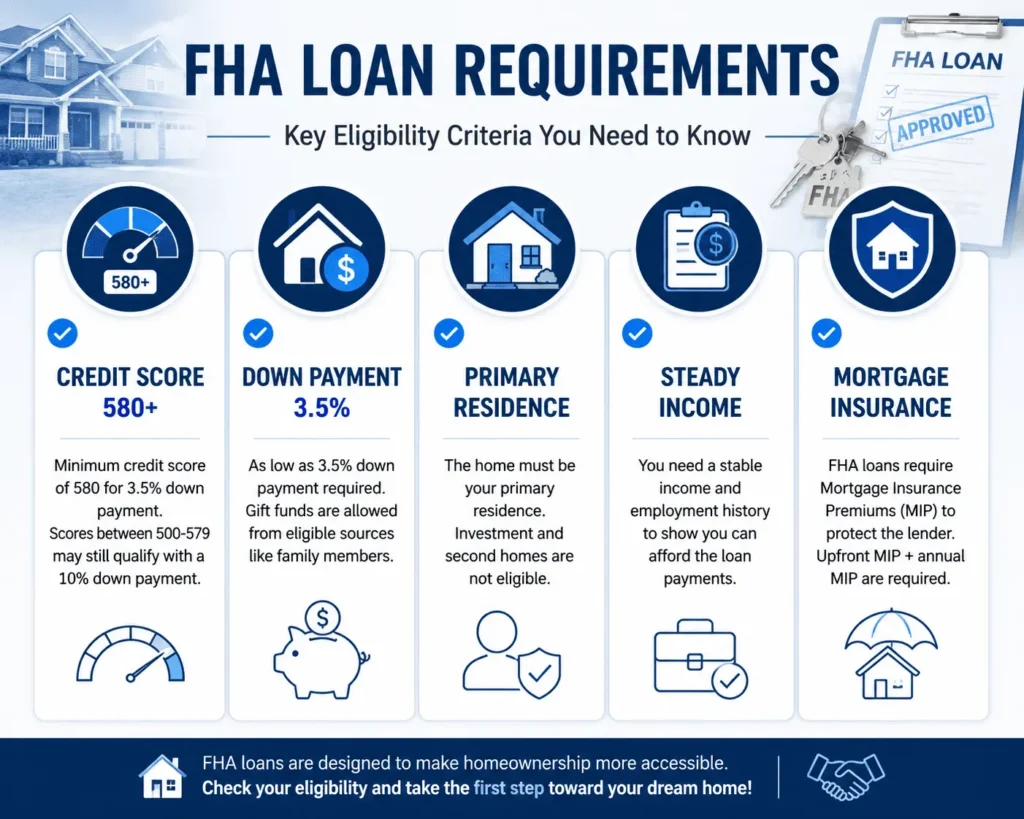
Five things decide approval: credit, debt load, income stability, the property, and residency status. Our full approval checklist covers every document a lender will request.
Basic Eligibility Criteria
- A credit score of 580 for 3.5% down, or 500 to 579 with 10% down
- Steady income, usually backed by two years of work history
- A valid Social Security number and legal age to sign in Indiana
- No delinquent federal debt, confirmed through a CAIVRS check
- Intent to occupy the home within sixty days of closing
FHA loan eligibility
One rule changed in 2025 and still catches families off guard. Since May 25, 2025, only U.S. citizens and lawful permanent residents qualify. Work-visa holders who once used this route now need a conventional or non-QM product. A Social Security card alone no longer proves status, so lenders ask for USCIS documentation.
Waiting periods after bankruptcy or foreclosure
Past credit trouble does not disqualify you, but it does start a clock:
- Chapter 7 bankruptcy: generally two years from discharge
- Chapter 13 bankruptcy: one year of on-time plan payments with court approval
- Foreclosure or deed in lieu: generally three years
- Short sale: three years, with exceptions when payments were current
Property Types
An FHA housing loan is not limited to a single detached house:
- Single-family homes
- Two, three, and four-unit buildings, if you live in one unit
- Condos in an approved project, or one unit through single-unit approval
- Manufactured homes on a permanent foundation
- Mixed-use property where at least 51% of the space is residential
Three and four-unit purchases must pass a self-sufficiency test, meaning projected rent covers the payment. Duplexes skip that test, which keeps them the easiest entry point for house-hacking.
Property requirements
An approved appraiser checks value and Minimum Property Requirements. Safe, sound, and secure is the standard. Peeling paint on a pre-1978 house, a failing roof, exposed wiring, or no working heat can freeze the file until repairs happen.
An appraisal is not a home inspection, so hire your own inspector. Your lender also needs its mortgagee clause listed correctly on the policy before funds release.
FHA appraisal vs home inspection
These two get confused constantly and they do different jobs. The appraisal protects the lender by confirming value and basic safety, and you cannot skip it. A home inspection protects you by finding what the appraiser never looks at, like the furnace age or slow drains. One more detail worth knowing: the appraisal attaches to the property and case number for 180 days, so if your deal collapses, the next buyer using the same financing inherits that value.
Debt-to-Income Ratio
Underwriters watch two figures: housing costs near 31% of gross monthly income, and total debt near 43%. Automated underwriting approves many files above that, sometimes past 50%, when reserves or scores are strong. Paying down one card before applying moves this faster than a raise.
Loan limit
Every county carries a cap on the insured amount. The national floor for a one-unit home in 2026 is $541,287, and most Indiana counties sit right at that floor. The full table appears later in this guide.
Mortgage insurance
Every file carries insurance, no matter the down payment. It arrives in two parts, one paid at closing and one spread across monthly payments. If your situation has an odd wrinkle, such as a recent job change or a past short sale, send the details to james@allthings-mortgage.com before you apply.
Types of FHA Loans
FHA mortgage loans come in several shapes. Most buyers use one; the rest solve specific problems.
Traditional FHA loan
This is the standard purchase product. Fixed or adjustable rate, 3.5% down, primary residence only, covering one to four units and up to 96.5% of value.
FHA energy efficient mortgage
The Energy Efficient Mortgage folds upgrade costs into the same loan. New windows, insulation, a modern furnace, or a heat pump all qualify, with a home energy assessment setting the allowed amount. Lower utility bills offset the slightly larger payment, and in older Indiana housing stock that math often works.
FHA 203(b) loans
Section 203(b) is the formal name for the standard program above. Any FHA house loan for a normal move-in-ready purchase runs through this section.
FHA 203(k) loans
This covers homes needing work. The Limited version handles cosmetic repairs; the Standard version covers structural work and requires a HUD consultant. In June 2026 the agency increased allowed draw requests on the Limited version.
Section 245(a)
Section 245(a) is a graduated payment mortgage. Payments start low and step up on a fixed schedule for the first several years. It suits borrowers whose income should climb predictably, like a medical resident. Run those later payments through your budget first.
FHA title I loans
Title I funds repairs, improvements, and manufactured home purchases rather than standard home buying. Under the 21st Century ROAD to Housing Act, signed into law on July 11, 2026, these property improvement loans can also pay for an accessory dwelling unit. Most of that law takes effect January 7, 2027.
Home equity conversion mortgage
The Home Equity Conversion Mortgage is the agency’s reverse mortgage for homeowners aged 62 and older. It turns equity into cash with no monthly payment, and the balance comes due when the home sells. Heirs face real decisions then, which our guide to a Carrington reverse mortgage lays out honestly.
FHA refinance
Existing owners can refinance into a new FHA home loan for a better rate, a different term, or cash. Cash-out is capped at 80% of value. If pulling equity is the goal, weigh it against a credit line using our home equity and HELOC comparison.
Streamline FHA refinance
The Streamline option skips the appraisal and often the income check. It only works when you already hold a government-insured mortgage and the new terms deliver a net tangible benefit. Refinance within three years and part of your original upfront premium comes back. Start by requesting a payoff statement, since your monthly balance is not the payoff figure.
How to get an FHA loan
The path is the same whether you use an agent or handle it alone. Order matters more than speed.
Helping Clients Apply for an FHA Loan
Agents move these files faster when they know the sequence. Buyers can follow the identical order:
- Pull your own credit report and dispute errors first
- Gather two years of W-2s, recent pay stubs, and two months of bank statements
- Get a full pre-approval letter, not a soft pre-qualification
- Search only for homes that can realistically pass the appraisal
- Let the lender order the appraisal and assign your case number
- Read the Closing Disclosure carefully, three days before signing
One quiet win from June 2026: the agency retired the old Important Notice to Homebuyers form at application.
Find an FHA-approved lender
Not every bank holds approval to write these mortgages, and HUD keeps a searchable list. Pricing varies widely between FHA loan lenders, so collect three Loan Estimates on the same day and compare them line by line.
Reading an honest review before you call saves hours. Our write-ups on Guild Mortgage and Citizens Mortgage cover service and fees, while our look at Guild Mortgage interest rates explains why a posted rate rarely matches your quote.
FHA loan calculator
A calculator only helps when you feed it every piece. Most tools show principal and interest, then stop, which is why the real payment surprises people. Include all five:
- Principal and interest on the base loan amount
- Property taxes, divided into monthly escrow
- Homeowners insurance, also escrowed
- Annual mortgage insurance, divided by twelve
- HOA or condo dues, if the property has them
Add the upfront premium to your balance first, since most buyers finance it. Then compare that total against your current rent.
What are down payment assistance programs?
Down payment assistance, or DPA, covers your 3.5% and sometimes part of closing costs. It comes from state agencies, cities, and nonprofits rather than the lender. In Indiana, the Indiana Housing and Community Development Authority runs the main statewide options.
Assistance usually arrives in one of four forms:
- Outright grants that never need repayment
- Forgivable second mortgages that disappear after a set number of years
- Deferred loans repaid only when you sell or refinance
- Employer-assisted housing benefits from hospitals, universities, and school districts
An Indiana first time home buyer usually starts with the state agency, then checks city programs in Indianapolis, Fort Wayne, and Evansville. Funds run out mid-year in some counties, so applying early genuinely matters.
Mortgage assistance programs
Help does not end at closing. When payments become hard, servicers must review you for loss mitigation before starting foreclosure. Options include forbearance, a repayment plan, a partial claim, or a permanent modification.
Call the moment you know a payment will be late. Most reviews begin through a customer service line, and your online payment portal often shows which programs you qualify for. Paying by check means using the correct office, since servicers split payments, payoffs, and insurance mail across different addresses, as our guides to Carrington mailing addresses and Valon mailing addresses explain.
Government-backed home loans and mortgage assistance
Three federal programs insure or guarantee home loans for everyday buyers. An FHA government loan works for almost anyone meeting the credit and occupancy rules. VA and USDA loans are narrower but far cheaper for those who qualify, so check them first.
Home buying help for specific groups
Several targeted options exist beyond the three big programs, and most buyers never hear about them.
American Indians and Alaska Natives
The Section 184 Indian Home Loan Guarantee Program serves enrolled members of federally recognized tribes. It allows low down payments and one capped guarantee fee instead of monthly insurance. Tribal housing authorities can point you toward participating lenders.
Veterans and service members
VA loans need no down payment and charge no monthly mortgage insurance. You pay a one-time funding fee instead, waived for many disabled veterans. If you served, compare a VA quote before anything else.
Rural homebuyers
USDA Section 502 loans also allow zero down inside eligible areas. Much of rural Indiana qualifies, including towns closer to metro edges than people assume. Income limits apply by county, so check the USDA map for the exact address.
Emergency personnel and teachers
The Good Neighbor Next Door program sells HUD-owned homes in revitalization areas at 50% off list price. Teachers, police officers, firefighters, and paramedics qualify. Buyers using federally insured financing put down $100 and must live there 36 months.
Energy-conscious homebuyers
Beyond the Energy Efficient Mortgage covered earlier, weatherization help and utility rebates cut upgrade costs before you finance them. Indiana utilities run their own schedules for insulation and HVAC work.
Do FHA loans have PMI?
No, and the distinction matters. PMI is the private product attached to conventional loans with less than 20% down. Government-insured mortgages carry MIP instead, paid to HUD. The names differ, and so do the cancellation rules.
Do FHA loans require mortgage insurance?
Yes, on every file, regardless of down payment. Upfront mortgage insurance runs 1.75% of the base loan amount, paid at closing or rolled into the balance. Annual mortgage insurance is billed monthly, and neither can be waived by a lender.
How much does FHA mortgage insurance cost?
Annual rates range from 0.15% to 0.75%, based on term, loan size, and down payment. Most thirty-year borrowers with less than 5% down land at 0.55%. On a $250,000 loan that is roughly $115 per month, and the upfront premium adds about $4,375 to the balance.
How to remove FHA mortgage insurance
With less than 10% down, the annual premium stays for the life of the loan. Put 10% or more down and it drops after eleven years. The common exit is refinancing into a conventional mortgage once you hold 20% equity. Your servicer’s mortgage insurance department can confirm which rule your case number follows.
How much are closing costs on an FHA loan?
Plan on 2% to 6% of the purchase price, or roughly $5,000 to $15,000 on a $250,000 home. The bill covers appraisal, title work, origination, recording fees, and prepaid taxes.
Your first year of homeowners insurance is collected upfront and escrowed, while later claims run through your servicer’s insurance department. If you are unsure which fees you can push back on, send your Loan Estimate to james@allthings-mortgage.com for a second read.
Some FHA closing cost fees are limited
Certain charges are capped or banned outright. Tax service fees cannot be passed to the borrower. Under the qualified mortgage rule, total points and fees stay under 3% on loans of $100,000 or more.
Sellers can cover your closing costs on an FHA loan
Sellers and other interested parties may contribute up to 6% of the sales price toward closing costs, prepaid items, and rate buydowns. That credit cannot touch your 3.5% down payment. Anything above 6% counts as an inducement to purchase and cuts the loan amount dollar for dollar.
What is the max FHA loan amount?
Limits reset yearly and follow the conforming loan limit set by the Federal Housing Finance Agency. The 2026 figures below apply to case numbers assigned on or after January 1, 2026.
| Property size | Low-cost floor (most Indiana counties) | High-cost ceiling |
| One unit | $541,287 | $1,249,125 |
| Two units | $693,050 | $1,599,375 |
| Three units | $837,700 | $1,933,200 |
| Four units | $1,041,125 | $2,402,625 |
Confirm your county figure on HUD’s lookup tool before writing an offer. A home priced $2,000 over the cap is not a small problem.
How long does it take to get an FHA loan?
Most purchases close in 30 to 45 days from accepted offer to keys, the same window as a conventional file. Appraisal scheduling causes the usual delay, and flagged repairs add a week or two. Answer document requests the same day and you stay near thirty.
Why sellers reject FHA offers and how to compete
In a multiple-offer market, some listing agents steer sellers away from government-backed buyers. The worry is that the appraiser will flag repairs the seller must then fix before closing. That fear is often outdated, but it still costs buyers houses every spring.
Four things make your offer land better:
- Get a full underwritten pre-approval, not a basic pre-qualification letter
- Skip homes with obvious appraisal problems, like peeling paint or a failing roof
- Shorten your inspection window rather than raising your price
- Have your agent call the listing agent directly and name your lender
Sellers respond to certainty, not loan type. An offer that closes on time beats a slightly higher one that might fall apart.
Compare and contrast conventional and FHA loans.
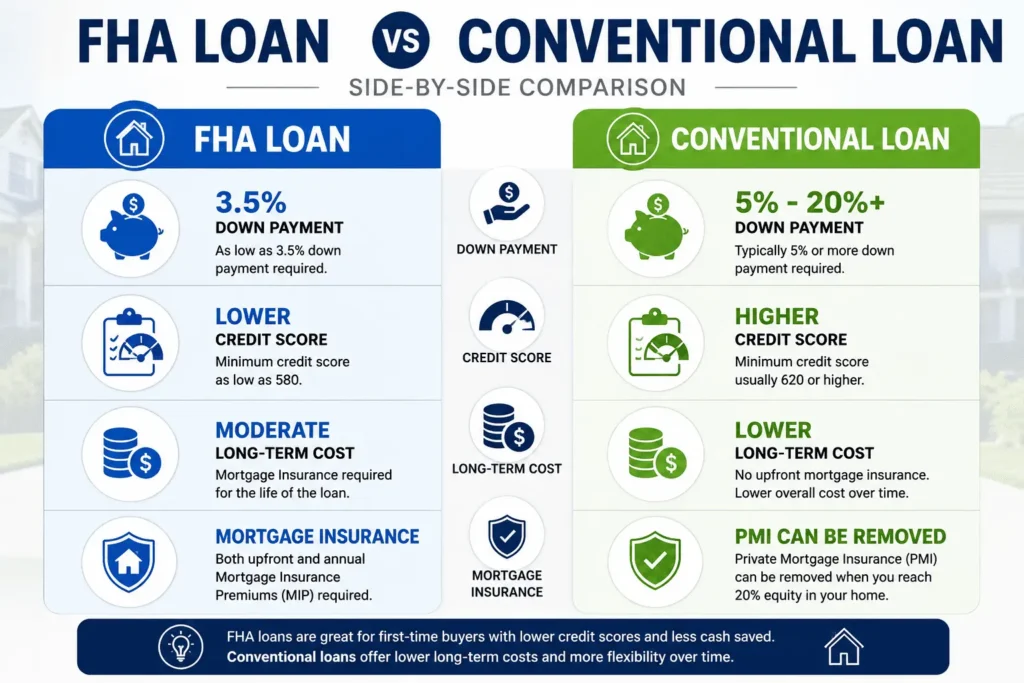
Conventional loans allow 3% down for first-time buyers and cancel mortgage insurance at 20% equity, making them cheaper long term for strong credit. FHA mortgages win on flexibility, not lifetime cost. The honest split looks like this:
- Credit under 660: government insurance usually wins on rate and approval odds
- Credit above 700 with 5% down: conventional often costs less over ten years
- High debt-to-income: government underwriting has more room
- Property needing repairs: the 203(k) option has no real conventional equal
- Selling within a few years: assumability adds real value at resale
Pull real quotes for both before deciding. Our reviews of Valon mortgage rates and Citizens Bank mortgage rates show how much the same profile varies between lenders.
A Guide to First-Time Home Buyer Programs
First time home buyers in Indiana have more support than most realize. The definition is generous: you count as a first-time buyer if you have not owned a primary residence in three years. The main tools worth checking:
- State agency programs offering down payment help with a fixed-rate mortgage
- Mortgage Credit Certificates, converting part of your interest into a yearly tax credit
- Free HUD-approved housing counseling, required by some assistance programs
- Local grants funded through city HOME dollars or county trust funds
Most Indiana first-time home buyer programs sit on top of government-insured financing rather than compete with it. A first-time home buyer in Indiana can often combine a state grant, a tax credit certificate, and a seller credit in one transaction.
How to Apply for a Mortgage
Application day is mostly paperwork. You complete the Uniform Residential Loan Application, sign disclosures, and authorize a credit pull. The lender then orders the appraisal and sends the file to underwriting.
Expect conditions to come back at least once; that is normal. After closing, set up your online account so you can track escrow and payments. Guides on reaching a Citizens mortgage login or a Guild Mortgage login dashboard show how to get that first sign-in working.
Should I get an FHA loan?
It comes down to which problem you are solving. This route makes sense when:
- Your credit score sits between 580 and 660
- Your down payment is under 5% and partly gifted
- Your debt-to-income ratio runs above 43%
- The home needs repairs a conventional appraisal would reject
Look at conventional financing instead when your score clears 700, you can put down 5% or more, and you plan to stay long enough for insurance removal to pay off.
At the start I promised plain answers on cost, eligibility, and the 2026 rule changes, and that ground is now covered. You know the 3.5% down payment rule, the 580 credit line, the $541,287 county floor most of Indiana falls under, and how mortgage insurance behaves over time. An FHA loan is not automatically the cheapest path, but for buyers short on cash or credit history it is often the only realistic one. Take your numbers to three approved lenders this week and let the math decide rather than the marketing.
Frequently Asked Questions
Can I buy a duplex with a federally insured mortgage?
Yes. Two-unit properties qualify as long as you live in one unit for at least a year. Rental income from the other unit can help you qualify, and duplexes skip the self-sufficiency test required on three and four-unit buildings.
Does an FHA appraisal expire?
An appraisal stays valid for 180 days from the effective date. It also attaches to the property and case number, not to you. If your purchase falls through, the next buyer using government financing inherits that same appraised value.
Can I have two FHA-insured mortgages at once?
Usually no, since occupancy rules limit you to one. Exceptions exist for job relocation beyond commuting distance, a growing family needing more space, or leaving a jointly owned home after divorce. Your lender must document the exception before approval.
Do government-insured loans allow non-occupant co-borrowers?
Yes. A parent, sibling, or other family member can co-sign without living in the home. Their income and credit both count toward qualifying, though their debts count too. This option rescues more applications than any other flexibility in the program.
Can I use gift money for the entire down payment?
Yes. The full 3.5% can come from a family member, employer, or approved assistance program. You need a signed gift letter stating the money is not a loan, plus bank records showing the transfer. Cash deposits without a trail get rejected.