
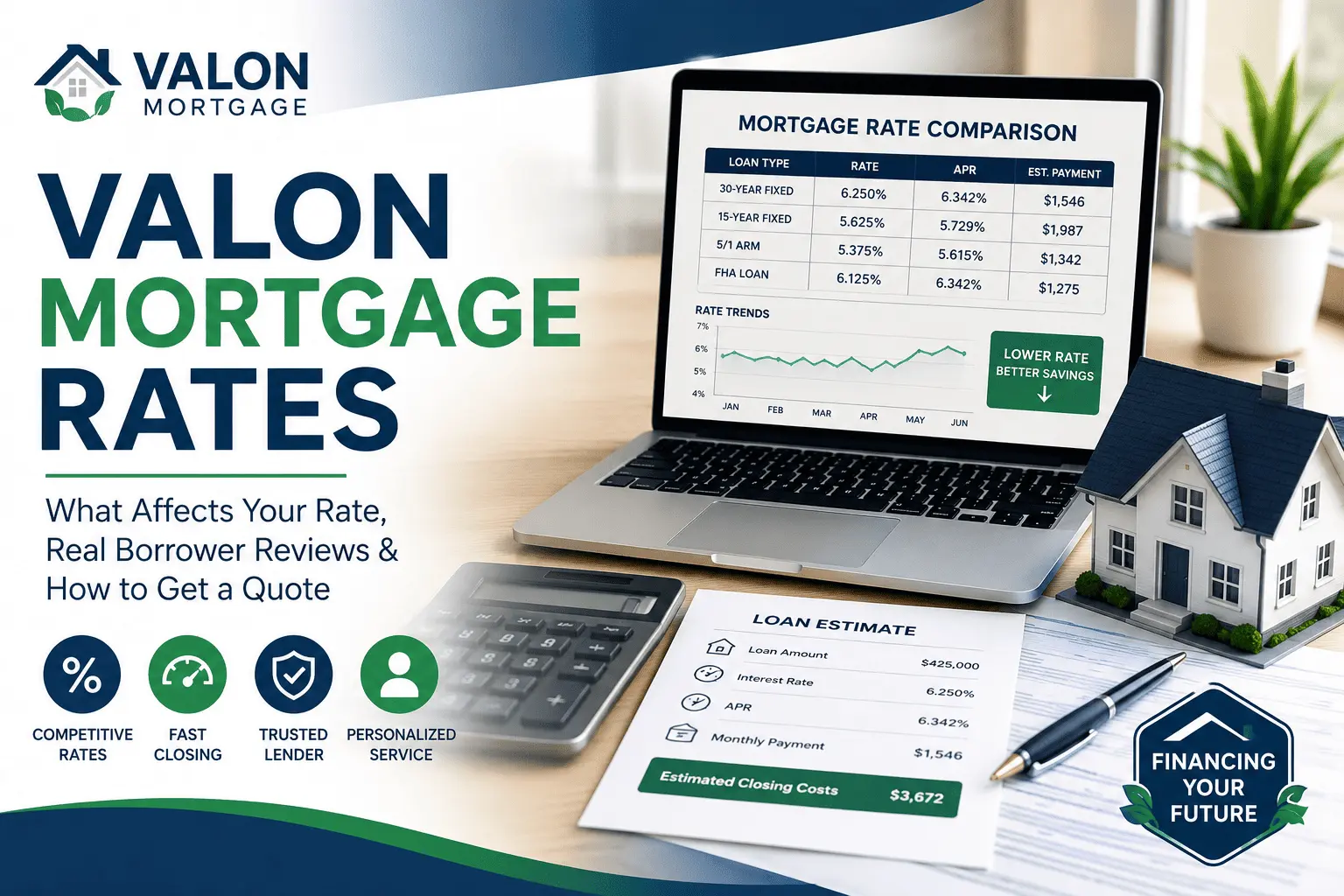
You land on Valon’s website ready to compare rates, and there is nothing there. No numbers, no chart, no starting point — just a button that says “apply now.” If that has already happened to you, you know exactly how that feels: like you are being asked to walk into a deal blind. Most lenders show you at least a starting rate before you fill out a single form. Valon does not, and that alone makes a lot of borrowers walk away before they even find out if the rate is actually good.
Here is what this article does for you. It breaks down exactly how Valon mortgage rates work, what six factors push your number up or down, and how to get a real rate quote without a hard pull on your credit. You will also see what real borrowers have paid — not just what Valon claims on their website. By the end, you will know whether Valon is worth your time and how to walk in fully prepared.
Does Valon Mortgage Publish Its Rates Online?
No — Valon does not post mortgage rates publicly. Valon Mortgage is a Fannie Mae and Freddie Mac approved lender and servicer founded in 2019. Their official position is that no single rate exists because every borrower’s number depends on their personal financial profile. This separates them from lenders like Rocket Mortgage or Better.com, which show live rate estimates upfront before you fill out any form.
This does not automatically mean their rates are bad. It means you have to take one extra step to find your number. The good news is that step does not have to hurt your credit — there is a soft-pull option that most borrowers never use because they do not know it exists.
What Factors Determine Your Valon Mortgage Rate

Your Valon mortgage rates are shaped by six key factors. Each one moves your final number up or down — knowing them before you apply puts you in a stronger position.
- Credit score carries the most weight of any single factor. Borrowers above 740 tend to get the best conventional pricing at Valon and across the industry. Scores below 680 will push your rate higher, and a few focused months of credit repair before applying can save thousands over a 30-year loan.
- Down payment size is the second biggest lever. Valon requires 10% to 20% down for conventional loans. Reaching 20% removes private mortgage insurance (PMI) from your monthly cost and typically earns a lower interest rate at the same time — two savings in one move.
- Debt-to-income ratio (DTI) tells Valon how much of your gross monthly income already goes to existing debt payments. A DTI at or below 43% is the standard threshold. If your DTI is above that, paying down a credit card or car loan before applying can push you into the preferred range and unlock better pricing.
- Loan type and term shape your rate directly. A 15-year fixed loan carries a lower rate than a 30-year fixed but comes with a higher monthly payment. An adjustable-rate mortgage (ARM) starts lower but can reset upward after the initial period. For borrowers planning to sell or refinance within five to seven years, an ARM saves real money. For long-term homeowners, a fixed rate offers the stability of knowing your payment will never change.
- Loan-to-value ratio (LTV) is tied to your down payment and property value. A lower LTV means the lender is taking on less risk, which typically translates to a better rate. Intended use of the property also plays a role — primary residences are priced better than investment properties or second homes, and Valon focuses on residential lending, so primary home buyers are in the strongest position.
Valon Mortgage Rates by Loan Type
Valon offers three main loan products, and each one is priced differently — so knowing which fits your situation is the first step toward getting the best Valon mortgage rates possible.
| Loan Type | Rate Options | Best For | Key Note |
|---|---|---|---|
| Conventional | Fixed + ARM | Good credit, 10–20% down | Fannie Mae / Freddie Mac backed |
| FHA | Fixed only | Lower credit, smaller down payment | Mortgage insurance premium required |
| Jumbo | Fixed + ARM | Loan amounts above $806,500 | Strong credit, higher qualification bar |
| Rate-and-Term Refi | Fixed + ARM | Lowering rate or shortening term | Slightly higher than purchase rate |
| Cash-Out Refi | Fixed + ARM | Accessing home equity as cash | Highest refi rate — costs more long term |
One important gap: Valon does not offer VA or USDA loans. Veterans and rural buyers will need a different lender for those programs. In 2026, the national average on a 30-year conventional loan sits near 6.42% and FHA loans average around 6.11%, according to Zillow and Curinos data. Use those benchmarks to evaluate any Valon quote you receive.
How to Get a Rate Quote from Valon Without Hurting Your Credit
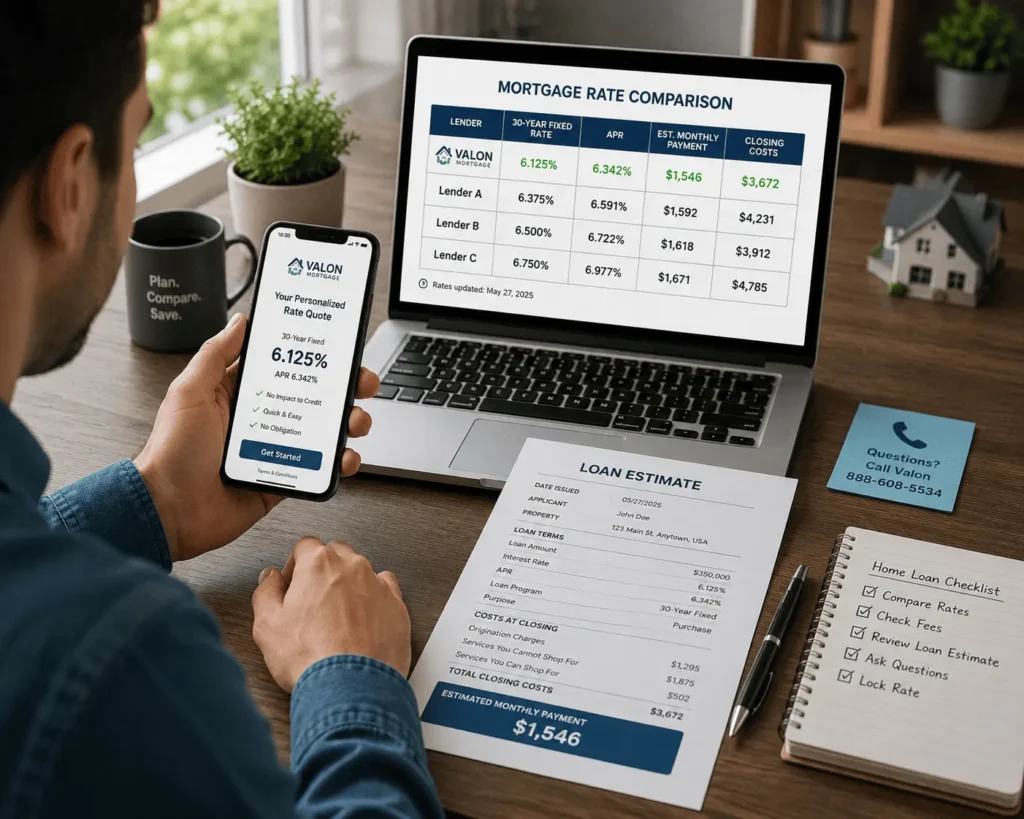
Most borrowers do not know this option exists. Valon allows you to get a rate estimate without a hard credit pull — here is exactly how to do it:
- Call Valon at 888-608-5534 (Monday–Friday, 11 AM–9 PM ET)
- Ask specifically to speak with a loan officer — not the online application system
- Request a rate estimate using an estimated credit score — this avoids a hard inquiry entirely
- Ask the loan officer to include a rate lock in your loan estimate once you decide to move forward
- Compare your Valon quote with at least two other lenders on the same day before committing
A rate lock protects you from market movement between your application and closing date. Valon targets closings in as little as 15 days in many cases, so the lock period does not need to be long — but always get it confirmed in your loan estimate document. A loan estimate is a standard federal form your lender must provide that shows your rate, APR, and all fees in writing before you commit to anything.
What Valon Customers Are Actually Saying About Their Rates
Valon describes their pricing as “amazingly low” and claims borrowers save an average of $1,243 in fees. Real borrower feedback tells a more layered story.
Customers who applied directly through Valon for a new home purchase generally report a smooth process. Positive reviews on Trustpilot mention responsive loan officers and fast closings. The more common complaints come from borrowers whose loans were transferred to Valon from another servicer — something that happens without the borrower choosing it.
Across BBB, ConsumerAffairs, and Trustpilot, here is what transferred borrowers report most often:
- Monthly payments increased after transfer due to escrow recalculation — one BBB reviewer reported a $372 monthly jump
- Force-placed insurance added to monthly cost even when active coverage was already in place
- Auto-pay errors triggered late fees on accounts set up correctly from day one
- Escrow mismanagement caused tax and insurance payment delays, leading to penalties the borrower had to resolve
Force-placed insurance means the servicer adds their own insurance policy to your account when they believe your existing coverage has lapsed — even if it has not. It costs significantly more than a standard policy and the borrower pays for it. Several Valon customers on ConsumerAffairs reported this happening in 2025 and 2026 despite submitting valid proof of existing coverage.
The honest takeaway: Valon’s interest rate may be competitive on paper. Your real monthly cost depends heavily on how they manage your escrow account after closing.
Valon Mortgage Fees That Impact Your True Rate Cost
Your interest rate and your actual cost of borrowing are two different numbers. The APR — annual percentage rate — is the number that tells the real story. It folds your interest rate and most fees into one figure so you can compare lenders on equal footing. Always ask Valon for the APR, not just the rate.
Valon does not publicly disclose origination fees or closing costs upfront, which makes early comparison harder. They claim fee savings for borrowers but do not break down exactly which fees are reduced. What the CFPB requires is that your lender provide a full loan estimate within three business days of receiving your application — that document shows every fee in writing before you commit.
Key fee facts confirmed on Valon’s published mortgage insurance department page:
- Late fees apply after your grace period expires — typically 15 days from your due date
- Valon does not charge to cancel your escrow or generate a payoff statement
- Escrow cushion requirements can raise your monthly payment above your principal and interest total
Federal guidelines allow servicers to hold up to two months of escrow as a reserve cushion. Multiple Valon borrowers on BBB have reported cushion recalculations that pushed their payments up significantly after transfer. Review the escrow section of your loan estimate line by line before signing anything.
Valon Refinance Rates — When Does It Make Sense?
Refinancing makes sense when Valon mortgage rates drop enough below your current rate to cover closing costs within a timeline that works for your plans. The break-even point is the key calculation. If refinancing costs $4,000 and saves $160 per month, you break even in 25 months. Stay in the home longer than that and the refinance pays off.
Three situations make refinancing with Valon worth a real conversation:
- Market rates have dropped at least 0.5% below your current rate
- Your credit score has improved enough to qualify for a meaningfully better loan-to-value pricing tier
- You want to shorten your loan term and reduce total interest paid over the life of the loan
Valon has one real advantage for existing customers exploring a refinance. Because they already service your loan and hold your full payment history, the underwriting process can move faster than starting fresh with a new lender. You can review your options through the Valon login portal or by calling their lending team directly. Cash-out refinancing is available for borrowers who want to access home equity — note that cash-out rates are priced higher than rate-and-term refinances, so weigh that extra cost against what you plan to do with the funds.
Is Valon Mortgage Right for You Based on Rates?
Valon is a legitimate, Fannie Mae and Freddie Mac approved lender with $230 million in total funding and operations across 46 states. That said, it is not the right fit for every borrower.
Valon works well if you:
- Want one company to handle both origination and servicing under one roof
- Need to close quickly — Valon targets 15-day closings in many cases
- Are buying a primary residence with a conventional, FHA, or jumbo loan
- Are an existing customer exploring a refinance with a servicer that already knows your history
Valon is not the right fit if you:
- Need a VA or USDA loan program
- Live in Hawaii, Massachusetts, Nevada, New York, or Utah
- Want to compare published rates before speaking to anyone
- Have had your loan transferred to Valon and are dealing with billing issues — document everything, contact Valon’s support team directly using the Valon phone number, and file a CFPB complaint if issues are not resolved in a reasonable timeframe
Conclusion
Valon mortgage rates are personalized, not published — and that means your rate depends entirely on what you bring to the table as a borrower. Credit score, down payment, DTI, and loan type are the four factors that move your number the most. The smart approach is to call Valon for a soft-pull quote, ask for the full APR on your loan estimate, and compare it with two other lenders before you decide. Valon has real strengths for the right borrower — go in prepared and you will be in the best position to make the decision that actually saves you money.
Frequently Asked Questions
Does Valon Mortgage publish its interest rates online?
No — Valon does not publish mortgage rates on their website. Your rate depends on your credit score, down payment, loan type, and debt-to-income ratio. The only way to get a number is to contact a loan officer directly at 888-608-5534 and request a soft-pull rate estimate.
What credit score do you need for the best Valon mortgage rates?
Valon does not publish a minimum credit score requirement. Borrowers with scores above 740 typically qualify for the most competitive rates on conventional loans. Scores below 680 may still qualify through Valon’s FHA loan program but at a higher rate with mortgage insurance added.
How do I get a Valon mortgage rate quote without a hard credit pull?
Call Valon at 888-608-5534 or email and ask a loan officer for a rate estimate using an estimated credit score. This avoids a hard inquiry on your credit report entirely. Only submit the full application when you are ready to move forward with a lender.
Does Valon Mortgage offer fixed and adjustable-rate mortgages?
Yes — Valon offers both fixed and adjustable-rate mortgages for conventional and jumbo loans. FHA loans are fixed-rate only. Fixed rates suit long-term homeowners who want stable payments. ARMs start lower and work best for buyers planning to sell or refinance within five to seven years.
When does refinancing with Valon Mortgage make financial sense?
Refinancing with Valon makes sense when market rates are at least 0.5% below your current rate, your credit score has improved, or you want to shorten your loan term. Calculate your break-even point first — divide total closing costs by your monthly savings to see how many months until you come out ahead.

One Comment