
Table of Contents
You found a house you like, and then the credit score talk started. One site says 580, another says 620. A friend told you that you need 20% down, but your neighbor bought a home with almost nothing saved. That mix of numbers can make you feel stuck before you even start.
This guide breaks down the real Qualifications for FHA Loan approval, step by step. You will learn what credit score, income, and property rules actually apply, so you walk into your first lender call with clear answers instead of guesses.
What Is an FHA Loan?
An FHA loan is a home loan backed by the Federal Housing Administration, a part of the U.S. Department of Housing and Urban Development, or HUD. The government does not lend you the money directly. Instead, it insures the loan, so banks and lenders take on less risk when they approve you.
That backing is why FHA loan qualifications stay more flexible than many other loan types. Lenders can approve buyers with lower credit scores and smaller savings, because HUD covers part of the risk if the loan ever defaults. This makes the program a strong choice for first-time buyers and people rebuilding their credit. You can read our full FHA loan guide for a broader look at how the program works from start to finish.
The FHA program started back in 1934, during a time when many families could not get approved for a normal home loan. It has helped millions of buyers since then, and it remains one of the most used loan types in the country today. Private lenders still handle your application, your paperwork, and your closing. HUD simply stands behind the loan in the background.
What Are the Requirements for an FHA Loan?
Every FHA-approved lender checks the same core areas before they say yes. These cover your credit, your income, your debt, and the home itself. Once you understand each piece, the Qualifications for FHA Loan approval stop feeling like a mystery. For a deeper breakdown of each rule, our FHA loan requirements page walks through every step.
Basic Eligibility Criteria
To start, you need a valid Social Security number and legal residency status in the United States. You must also be old enough to sign a legal mortgage contract in your state. The home also has to be your main residence, not a rental or vacation property.
Lenders also look at your past two years on paper, including past addresses, past jobs, and any prior bankruptcy or foreclosure records. Meeting this basic criteria for FHA loan approval opens the door to the next set of checks. Anyone asking who is eligible for FHA loan financing should start right here.
You do not have to apply alone. A spouse, parent, or close family member can join your application as a co-borrower, and their income can help you qualify for a larger loan. Just remember that their credit and debt will also count toward your final approval decision.
Credit Score Requirements
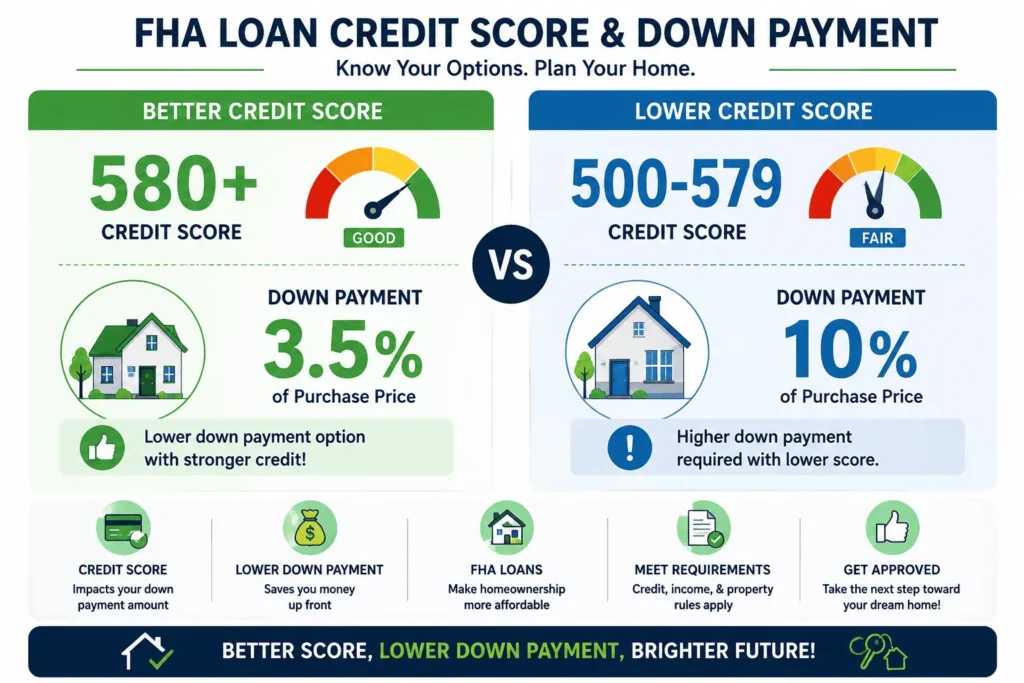
Your credit score decides your down payment amount and how easily lenders approve your application. A score of 580 or higher lets you move forward with just 3.5% down. A score between 500 and 579 still works, but you will need at least 10% down.
Improving your score even slightly can save you thousands over the life of the loan. Small, consistent habits, like paying every bill on time, matter more than any quick fix. Lenders reward steady patterns over sudden changes.
Scores under 500 will not meet the Qualifications for FHA Loan approval under HUD rules. Many lenders also set their own higher minimum, often around 620, even though the program technically allows lower. This is why it pays to check with more than one lender before you give up on a low score.
If your score sits close to a cutoff point, a few small steps can push it higher within a couple of months. Paying down credit card balances, fixing report errors, and avoiding new credit inquiries all help. Even a jump of ten or twenty points can move you into a lower down payment tier.
Down Payment Requirements
The FHA down payment can come from your own savings, a gift from family, or an approved assistance program. Most buyers pay 3.5% of the purchase price when their credit score sits at 580 or above. That is one of the lowest down payment rules in the mortgage world.
Gift funds need a signed letter proving the money is a gift, not a loan you must repay later. Down payment assistance programs through your state or county can also cover part or all of this cost. Ask your lender which local programs apply in your area before you assume you need full savings.
Do not confuse your down payment with your earnest money deposit. Earnest money is a smaller amount you pay upfront to show the seller you are serious, and it later counts toward your total down payment at closing. Your lender will explain how these two amounts fit together on your final paperwork.
Employment & Income History
Lenders want proof that your paycheck is steady. This usually means two full years of work history in the same field, even if you changed employers along the way. Gaps in work are allowed if you can explain them with school, military service, or medical reasons.
You will need recent pay stubs, W-2 forms, and often two years of tax returns. Self-employed buyers face extra paperwork, including profit and loss statements. These income qualifications for FHA loan approval prove you can handle monthly payments over the long term.
Switching jobs does not automatically hurt your application. Lenders mostly care that your new role stays in the same field and that your pay stayed steady or went up. A recent promotion or raise can even work in your favor, since it shows your income is heading in the right direction.
Debt-to-Income Ratio
Your debt-to-income ratio, or DTI, compares your monthly debt to your gross monthly income. FHA rules generally cap your housing costs at 31% of that income, known as the front-end ratio. Your total debt, including the new mortgage, usually should not pass 43%.
Some buyers with strong credit or extra savings can go above 43%, sometimes as high as 50%. This flexibility, called compensating factors, gives more people a real shot at meeting the Qualifications for FHA Loan approval. Paying down credit cards before you apply can lower your ratio fast.
Here is a simple example. If you earn $5,000 a month before taxes and your total monthly debts, including your new mortgage, add up to $2,000, your DTI is 40%. That number sits comfortably under the standard 43% limit, which gives you room to move forward with confidence.
Property Types
FHA loans can finance single-family homes, townhomes, approved condos, and manufactured homes on a permanent foundation. You can also buy a two- to four-unit building, as long as you live in one unit yourself. Each property must pass an FHA-approved appraisal before closing.
That appraisal checks the home’s value and its safety. Issues like a leaking roof, exposed wiring, or peeling lead paint can stop the loan until they get fixed. This step protects you from buying a home with hidden, costly problems.
Condos need extra care, since only HUD-approved condo projects can use FHA financing. Your real estate agent or lender can check a building against the approved list before you write an offer. Skipping this check early can waste weeks on a condo that never had a real chance of approval.
Occupancy Requirement
FHA loans exist for people who plan to live in the home. You must move in within 60 days of closing, and it needs to stay your primary residence. This rule rules out investment properties and most vacation homes.
If you buy a two- to four-unit property, you still need to occupy one unit yourself. The other units can bring in rental income to help with your payment. This is a common path for first-time buyers who also want to build long-term wealth.
The occupancy rule applies mainly at purchase time. If your life changes later, such as a job move, most lenders allow you to rent out the home after a reasonable period of owner occupancy. Talk to your loan servicer first, since rules can vary based on your original loan terms.
FHA Loan Limits
HUD sets a maximum loan amount each year, and it changes by county. For 2026, the national floor for a single-family home sits at $541,287, while high-cost counties can reach up to $1,249,125. Multi-unit properties allow even higher limits.
HUD updates these numbers every December for the following year, based on median home prices nationwide. You can search your exact county limit on the official HUD website before you set a shopping budget. A home that qualified last year might sit above or below the new limit today. Always confirm the current figure with your lender before you make an offer.
| Property Type | 2026 Floor Limit | 2026 Ceiling (High-Cost Areas) |
| 1-unit home | $541,287 | $1,249,125 |
| 2-unit home | $693,000 | $1,599,000 |
| 3-unit home | $837,750 | $1,933,275 |
| 4-unit home | $1,041,000 | $2,402,400 |
Check your exact county limit before you shop for homes, since prices above that limit will not qualify for FHA financing.
Loan limits matter most in fast-growing cities, where home prices can climb past the floor amount within a year or two. A buyer in a rural county may find plenty of homes under the limit, while a buyer near a major metro area might need the higher ceiling amount. Always confirm the current number for your exact county, since it can change every January.
Mortgage Insurance Premium (MIP) for FHA Loans
Every FHA loan requires mortgage insurance, which protects the lender if you stop paying. This comes in two parts: an upfront premium and an annual premium. The upfront cost is 1.75% of your loan amount, and most buyers roll it into the loan instead of paying cash.
The annual premium runs around 0.55% of your balance, split into monthly payments added to your mortgage bill. If your down payment was under 10%, this premium usually stays for the life of the loan. Buyers with 10% or more down can drop it after 11 years, so this cost is worth planning around before you commit.
Ask your loan officer to show you the exact premium numbers for your specific loan amount before you sign anything. Every lender must disclose this cost clearly on your loan estimate form.
Conventional loans use a different system called private mortgage insurance, or PMI, which usually costs less each month. However, PMI often requires a higher credit score to qualify for the lowest rates. Many buyers still choose FHA financing anyway, since the lower upfront barrier outweighs the added insurance cost over time.
How Do FHA Loans Work?
Once you close on an FHA loan, it works like any other mortgage. You make one monthly payment that covers principal, interest, taxes, insurance, and your mortgage insurance premium. The FHA backing stays in place behind the scenes, protecting your lender if you ever default.
Your lender still handles every part of the process, from your first application to your final signature at closing. HUD never talks to you directly during a purchase. Its role stays behind the paperwork, guaranteeing part of the loan so your lender feels safe approving buyers who might otherwise get turned away.
Are FHA Loans for Low-Income Households?
FHA loans were built with affordability in mind, but they are not only for low-income buyers. There is no maximum income limit on a standard FHA loan. What matters more is your DTI ratio and your ability to handle the monthly payment.
That said, the low down payment and flexible credit rules do help buyers with tighter budgets. Many state and local down payment assistance programs pair well with FHA loans for lower-income households. This combination often makes homeownership possible years earlier than saving alone would allow.
Households at any income level can apply, from a single teacher buying a first condo to a growing family upgrading to a bigger house. What stays consistent is the underwriting process, since every file gets checked against the same credit, income, and debt rules regardless of how much you earn.
Are FHA Loans for First-Time Buyers?
FHA loans are especially popular with first-time buyers, though repeat buyers can use them too. The low 3.5% down payment and relaxed credit rules remove two of the biggest hurdles new buyers face. You also do not need a large emergency fund on top of your down payment.
You can even use an FHA loan again later, as long as the new home becomes your primary residence. Buyers with a past FHA loan just need to show they still meet current qualifications for FHA loan approval on their new application.
Most first-time buyer education also lines up naturally with FHA rules. Many state programs actually require a short homebuyer class before you close, and that class often pairs directly with FHA-backed financing. It is a small extra step that leaves you better prepared for homeownership overall.
FHA Loans vs. Conventional Loans
FHA and conventional loans serve different types of buyers. Conventional loans usually need a higher credit score, often 620 or more, and stricter debt limits. FHA loans open the door to buyers with lower scores and smaller savings, which is why so many people meet the Qualifications for FHA Loan approval before they ever qualify for a conventional deal.
| Feature | FHA Loan | Conventional Loan |
| Minimum credit score | 500-580 | 620+ |
| Minimum down payment | 3.5% | 3-5% with strong credit |
| Mortgage insurance | UFMIP + annual MIP | PMI, removable at 20% equity |
| DTI limit | Up to 43-50% | Usually 36-45% |
| Property type | Primary residence only | Primary, second home, or rental |
Conventional loans can drop mortgage insurance once you reach 20% equity, while FHA insurance often lasts longer. If your credit is strong and your savings are solid, a conventional loan may save money over time.
Neither option is universally better. A buyer with a 610 credit score and 4% saved usually leans FHA, while a buyer with a 740 score and 15% saved often does better with conventional financing. Running both numbers side by side with a lender is the only way to know for certain which path fits your situation.
Different Types of FHA Loans
FHA offers more than one loan program, built for different needs.
- FHA 203(b): The standard purchase loan most buyers use for a primary home.
- FHA 203(k): A renovation loan that rolls repair costs into your mortgage.
- FHA Streamline Refinance: A fast refinance option for current FHA borrowers with less paperwork.
- FHA Reverse Mortgage (HECM): A program for homeowners 62 and older to access home equity.
- Energy Efficient Mortgage: Adds funds for approved energy-saving home upgrades.
Each program shares the same core Qualifications for FHA Loan approval, with a few extra rules layered on for the specific purpose.
A buyer looking at a fixer-upper often benefits most from the 203(k) option, since it avoids taking out a separate renovation loan later. Someone who already owns an FHA-financed home and just wants a lower rate usually finds the Streamline Refinance faster and simpler. Picking the right program starts with matching it to your actual goal, not just the lowest rate you see advertised.
What Are the Advantages of FHA Loans?
FHA loans open doors that many other programs keep closed. The down payment stays low, credit rules stay flexible, and gift funds are welcome. Closing costs can also be rolled into the loan in some cases, lowering your cash needed at closing.
This flexibility answers a common question buyers ask: can anyone get an FHA loan? Not everyone will qualify, but the wider credit and income rules mean far more buyers get a real chance compared to conventional financing.
A quick look at the biggest advantages makes the appeal clear:
- Down payments as low as 3.5%, with gift funds allowed
- Credit scores as low as 500 accepted, with reasonable overlays at most lenders
- Higher DTI limits than most conventional programs allow
- Assumable loans, meaning a future buyer can take over your rate
- Available for one- to four-unit properties, opening the door to rental income
Are There Potential Downsides to FHA Loans?
The biggest downside is the mortgage insurance premium, which often lasts the life of the loan on low down payment deals. FHA loan limits can also block you from buying in expensive markets if the home price runs too high. The property itself must pass a strict appraisal, which can slow down or stop a sale.
Sellers in competitive markets sometimes prefer conventional buyers, since FHA appraisals carry stricter repair rules. None of this rules out the Qualifications for FHA Loan approval for most buyers, but it helps to know these trade-offs before you commit.
A strong offer letter and a solid pre-approval can ease seller concerns in most cases. Working with an agent who understands FHA financing also helps, since they can guide you toward listings that are more likely to pass the appraisal without extra delays.
How Do I Apply for an FHA Loan?

Start by checking your credit report and fixing any errors you find. Next, gather your pay stubs, tax returns, and bank statements from the past two years. Then, reach out to an FHA-approved lender to get pre-qualified, which tells you your realistic price range.
A typical FHA application file includes:
- Two years of W-2 forms or tax returns
- Thirty days of recent pay stubs
- Two months of full bank statements
- A valid photo ID and Social Security card
- Landlord or mortgage payment history for the past twelve months
Once pre-qualified, you can begin house hunting with a clear budget in mind. After you sign a purchase agreement, the lender orders an appraisal and finishes your full underwriting review. If you still have questions about what qualifies you for a FHA loan along the way, you can reach out at james@allthings-mortgage.com for direct guidance.
Most FHA applications move from pre-approval to closing in about 30 to 45 days, depending on how fast the appraisal and title work move. Staying responsive with your lender, and avoiding new debt during this window, keeps your file on schedule. A calm, organized process now saves real stress later.
Other Affordable Options for Homebuying
FHA loans are not the only affordable path to homeownership. A few other options are worth comparing before you decide.
- USDA loans: Zero down payment option for eligible rural and suburban areas.
- VA loans: No down payment required for qualified veterans and active service members.
- State first-time buyer programs: Grants and low-interest loans for local residents.
- Conventional 97 loans: Just 3% down for buyers with strong credit.
Comparing these options against the Qualifications for FHA Loan approval helps you pick the loan that fits your income, location, and long-term goals.
A veteran with strong credit might save more through a VA loan, while a family eyeing a rural property could do better with USDA financing. FHA still tends to win for buyers who want a simple, predictable path with lower credit and down payment barriers. Comparing quotes across all of these options only takes a few phone calls. A short conversation now can save real money over the full life of your loan.
Frequently Asked Questions
What are the qualifications for an FHA loan?
You generally need a credit score of at least 500, steady income for two years, a DTI under 43-50%, and a home you plan to live in. Down payment ranges from 3.5% to 10% based on your credit score.
Who qualifies for FHA loan approval?
Most working adults with valid income documents, a Social Security number, and a credit score of 500 or higher can qualify. Lenders also check your DTI ratio and past housing or rental payment history.
Do I qualify for FHA loan approval with bad credit?
Yes, scores as low as 500 can still qualify, though you will need a 10% down payment instead of 3.5%. Many lenders set their own higher minimum, so shopping around helps.
Can I qualify for an FHA loan after bankruptcy?
Yes, most buyers can qualify two years after a Chapter 7 discharge or one year into a Chapter 13 repayment plan. You will need to show rebuilt credit and steady payments since then.
How does self-employment income affect FHA approval?
Self-employed buyers need two years of tax returns, a profit and loss statement, and a steady or growing income trend. Lenders average your income across both years to judge your true qualifying amount.
Conclusion
Understanding the full Qualifications for FHA Loan approval turns a confusing process into a clear checklist. You now know the credit score, down payment, income, and property rules that lenders actually use. As promised at the start, the guesswork around credit numbers and down payments is gone. With this roadmap, you can walk into your next lender conversation ready and confident.